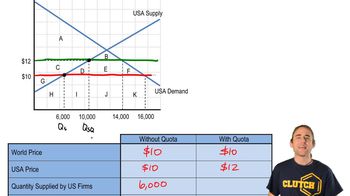
An import quota is a government-imposed numerical limit on the number of units of a good that can be imported into a country.
How does an import quota affect the domestic price of a good?
An import quota raises the domestic price of a good by restricting supply, as seen when the price increased from \$2.50 to \$4.00 for oversized lollipops.
What happens to consumer surplus when an import quota is imposed?
Consumer surplus decreases because higher prices and reduced availability make consumers worse off.
How does an import quota impact domestic producer surplus?
Domestic producer surplus increases since domestic producers face less competition from imports and can sell at higher prices.
Who benefits from the higher prices created by an import quota?
Foreign producers benefit by capturing surplus, as they can sell their limited imports at the higher domestic price.
What is deadweight loss in the context of import quotas?
Deadweight loss is the inefficiency and loss of economic welfare caused by preventing mutually beneficial trades due to the quota.
How does an import quota compare to a tariff in terms of economic effects?
Both import quotas and tariffs raise domestic prices and reduce imports, but quotas do not generate government revenue.
Who receives the surplus that would have gone to the government under a tariff when an import quota is used?
With an import quota, the surplus goes to foreign producers instead of the government.
What is a Voluntary Export Restraint (VER)?
A VER is a self-imposed quota by the exporting country, often for political reasons, limiting the amount exported.
How are the economic outcomes of a VER similar to those of an import quota?
Both VERs and import quotas result in higher domestic prices, reduced imports, and increased producer surplus for domestic and foreign producers.
Why might a government choose an import quota over a tariff?
A government might choose a quota for political reasons, as it allows foreign producers to benefit rather than the government collecting revenue.
What happens to government revenue when an import quota is imposed?
Government revenue remains zero because no tax is collected under an import quota.
How does the quantity of imports change when a quota is imposed?
The quantity of imports decreases to the quota limit, such as from 65,000 units to 25,000 units in the example.
What is the main difference between a tariff and an import quota?
The main difference is that tariffs generate government revenue, while quotas benefit foreign producers with surplus.
What is the political motivation behind voluntary export restraints?
VERs are often used to avoid conflict and appease trading partners by allowing the exporting country to limit exports voluntarily.
 Back
Back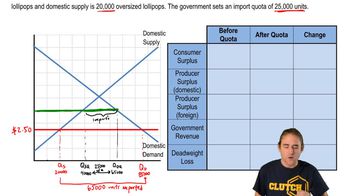
 14:08
14:08