Skip to main content
Macroeconomics
My Course
Learn
Exam Prep
AI Tutor
Study Guides
Flashcards
Explore
Try the app
My Course
Learn
Exam Prep
AI Tutor
Study Guides
Flashcards
Explore
Try the app
Back
Income Equality and Efficiency quiz
You can tap to flip the card.
What is utility in economics?
You can tap to flip the card.
👆
What is utility in economics?
Utility is a quantitative measure of happiness or satisfaction that individuals receive from consuming goods or services.
Track progress
Control buttons has been changed to "navigation" mode.
1/15
Related flashcards
Recommended videos
Income Equality and Efficiency definitions
Income Equality and Efficiency
14 Terms
Guided course
06:41
Income Equality and Efficiency
3
views
Terms in this set (15)
Hide definitions
What is utility in economics?
Utility is a quantitative measure of happiness or satisfaction that individuals receive from consuming goods or services.
What does marginal utility refer to?
Marginal utility is the additional satisfaction or happiness gained from consuming one more unit of a good or spending one more dollar.
How does the concept of diminishing marginal utility relate to income?
As a person receives more income, each additional dollar provides less additional satisfaction, illustrating diminishing marginal utility.
Why does redistributing income from a wealthier to a poorer individual increase total utility?
Because the poorer individual gains more utility from each additional dollar than the wealthier individual loses, increasing overall satisfaction.
What is the equality-efficiency trade-off?
It is the idea that increasing income equality can reduce incentives to work, leading to a loss in economic efficiency.
What is the opportunity cost of achieving perfect income equality?
The opportunity cost is reduced efficiency, as people may lack incentives to work hard if everyone earns the same regardless of effort.
How does perfect equality affect people's incentives to work?
Perfect equality removes the incentive to work hard, since everyone receives the same income regardless of effort.
What happens to total utility when income is redistributed evenly between two people with different incomes?
Total utility increases because the gain in utility for the poorer person is greater than the loss for the richer person.
Why does the marginal utility curve slope downward?
It slopes downward due to diminishing returns, meaning each additional dollar provides less satisfaction than the previous one.
How does the government’s redistribution of income impact aggregate demand?
Redistribution can increase aggregate demand by giving more income to those with a higher marginal propensity to consume.
What is meant by 'efficiency' in the context of income distribution?
Efficiency refers to the optimal allocation of resources where incentives to work and produce are maintained.
How does the equality-efficiency trade-off reflect opportunity costs in fiscal policy?
It shows that policies promoting equality may reduce efficiency, representing the opportunity cost of such interventions.
Why might a superstar gain less utility from buying a 13th car compared to someone buying their first?
Because of diminishing marginal utility, the superstar values each additional car less than someone who has none.
What is the main benefit of income equality according to the lesson?
The main benefit is maximizing total utility by allocating income where it provides the most satisfaction.
How does balancing income distribution impact economic growth?
Balancing income distribution affects labor supply, productivity, and thus the overall economic growth by influencing incentives and aggregate demand.
 BackBack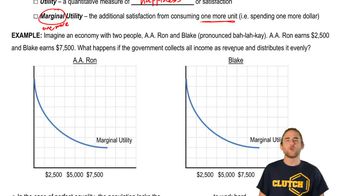
 06:41
06:41