Skip to main content
Macroeconomics
My Course
Learn
Exam Prep
AI Tutor
Study Guides
Flashcards
Explore
Try the app
My Course
Learn
Exam Prep
AI Tutor
Study Guides
Flashcards
Explore
Try the app
Back
Isocost Lines quiz
You can tap to flip the card.
What does an isocost line represent in production decisions?
You can tap to flip the card.
👆
What does an isocost line represent in production decisions?
An isocost line shows all combinations of two inputs, such as labor and capital, that result in the same total cost for a firm.
Track progress
Control buttons has been changed to "navigation" mode.
1/15
Related flashcards
Recommended videos
Isocost Lines definitions
Isocost Lines
15 Terms
Guided course
04:27
Isocost Lines
3
views
Terms in this set (15)
Hide definitions
What does an isocost line represent in production decisions?
An isocost line shows all combinations of two inputs, such as labor and capital, that result in the same total cost for a firm.
How do you calculate the maximum quantity of an input a firm can afford?
Divide the firm's budget by the price of the input to find the maximum quantity it can afford.
If ovens cost \$6,000 each and the budget is \$24,000, how many ovens can the firm afford?
The firm can afford 4 ovens, since \$24,000 divided by \$6,000 equals 4.
If bakers cost \$3,000 each and the budget is \$24,000, how many bakers can the firm afford?
The firm can afford 8 bakers, since \$24,000 divided by \$3,000 equals 8.
What are the endpoints of the isocost line in the Spooky Cookies example?
The endpoints are 4 ovens and 0 bakers, and 0 ovens and 8 bakers.
On which axes are labor and capital typically plotted in isocost diagrams?
Labor is usually plotted on the x-axis and capital on the y-axis.
Why is the isocost line straight in the example provided?
The isocost line is straight because input prices do not change as quantities change.
What does any point on the isocost line indicate about input combinations?
Any point on the isocost line represents a combination of labor and capital that uses the entire budget.
How can firms use isocost lines to minimize production costs?
Firms compare isocost lines with isoquant lines to find the input mix that achieves desired output at the lowest cost.
What is the formula for finding the maximum quantity of an input given a budget?
Maximum quantity = Budget ÷ Price of the input.
What does the intersection of an isocost line and an isoquant curve represent?
It represents the least-cost combination of inputs to produce a given level of output.
Why is it important for firms to analyze different input combinations?
Analyzing input combinations helps firms achieve desired output levels at the lowest possible cost.
What role does the capital–labor ratio play in production decisions?
The capital–labor ratio helps firms decide the mix of inputs to use based on cost and production needs.
How does a firm determine which input mix to choose along the isocost line?
The firm selects the input mix that aligns with its production goals and minimizes costs, often using isoquant curves for comparison.
What is the significance of budget constraints in production?
Budget constraints limit the combinations of inputs a firm can afford, guiding cost minimization strategies.
 BackBack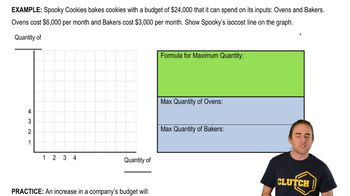
 04:27
04:27