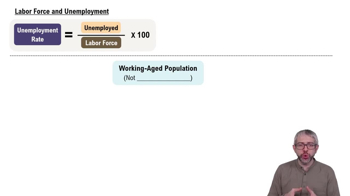
How do you calculate the unemployment rate for an economy using labor force data?
The unemployment rate is calculated by dividing the number of unemployed individuals by the total labor force (employed plus unemployed), then multiplying by 100 to get a percentage.
Which factors best explain the unemployment rate in Mexico?
The unemployment rate in Mexico can be influenced by factors such as discouraged workers not being counted, underemployment due to part-time work, and inaccuracies in survey data, all of which can understate or distort the true unemployment rate.
If the unemployment rate is 9 percent and the natural rate of unemployment is 5 percent, what does this indicate about the economy?
This indicates that the economy is experiencing cyclical unemployment, as the actual unemployment rate exceeds the natural rate, often due to economic downturns or recessions.
What is meant by the equilibrium (or natural) unemployment rate?
The equilibrium unemployment rate, also known as the natural rate of unemployment, is the rate that exists when the labor market is in balance, including only frictional and structural unemployment, and excluding cyclical unemployment.
Who is considered 'not in the labor force' according to labor force definitions?
Individuals such as full-time students, homemakers, retirees, and discouraged workers who are not actively seeking work are considered 'not in the labor force.'
What is the formula for calculating the labor force participation rate?
The labor force participation rate is calculated by dividing the labor force by the total adult population and multiplying by 100 to get a percentage.
How does underemployment affect the accuracy of the unemployment rate?
Underemployment, where part-time workers want full-time jobs, causes the unemployment rate to understate the true level of joblessness because these individuals are counted as employed.
Why might survey results distort the reported unemployment rate?
Survey results can be distorted if individuals misreport their job-seeking status to maintain benefits or hide illegal employment, leading to inaccurate unemployment figures.
What impact do discouraged workers have on the measured unemployment rate during a recession?
During a recession, the number of discouraged workers increases, which leads to an understatement of the unemployment rate because these individuals are no longer counted as unemployed.
What is the employment-to-population ratio and how is it calculated?
The employment-to-population ratio is calculated by dividing the number of employed individuals by the total adult population and multiplying by 100 to express it as a percentage.
How is the unemployment rate defined and what does it measure in the context of the labor force?
The unemployment rate is defined as the percentage of unemployed individuals in the labor force. It measures the proportion of people who are actively seeking work but unable to find a job, relative to the total labor force.
What is one reason why unemployment statistics may be unreliable?
Unemployment statistics may be unreliable because discouraged workers, who have given up searching for jobs, are not counted as unemployed, leading to an understatement of the true unemployment rate.
What is the best definition of unemployment in macroeconomics?
Unemployment refers to individuals who are actively seeking work but are unable to find a job.
 Back
Back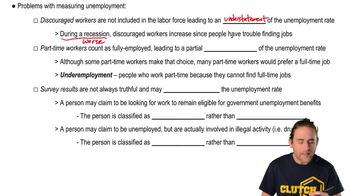
 04:35
04:35