Skip to main content
Macroeconomics
My Course
Learn
Exam Prep
AI Tutor
Study Guides
Flashcards
Explore
Try the app
My Course
Learn
Exam Prep
AI Tutor
Study Guides
Flashcards
Explore
Try the app
Back
Monopoly Efficiency and Deadweight Loss definitions
You can tap to flip the card.
Monopoly
You can tap to flip the card.
👆
Monopoly
A market structure where a single firm restricts output to raise prices, resulting in higher profits and reduced market efficiency.
Track progress
Control buttons has been changed to "navigation" mode.
1/14
Related flashcards
Recommended videos
Monopoly Efficiency and Deadweight Loss quiz
Monopoly Efficiency and Deadweight Loss
15 Terms
Guided course
12:19
Monopoly Efficiency and Deadweight Loss
4
views
Terms in this set (14)
Hide definitions
Monopoly
A market structure where a single firm restricts output to raise prices, resulting in higher profits and reduced market efficiency.
Perfect Competition
A market scenario where many firms produce at minimum cost, ensuring price equals marginal and average total cost.
Consumer Surplus
The area above market price and below the demand curve, representing the benefit buyers receive from paying less than their maximum willingness.
Producer Surplus
The area below market price and above the supply curve, reflecting the benefit sellers gain from selling above their minimum acceptable price.
Total Surplus
The sum of consumer and producer surplus, indicating the overall economic welfare generated in a market.
Deadweight Loss
The lost economic value from trades that do not occur due to market inefficiency, often visualized as missing areas on a surplus graph.
Productive Efficiency
A situation where goods are produced at the lowest possible cost, specifically at the minimum point of the average total cost curve.
Allocative Efficiency
A condition where production matches consumer preferences, achieved when marginal benefit equals marginal cost.
Marginal Cost
The additional expense incurred from producing one more unit, represented by the upward-sloping supply curve in competition.
Marginal Revenue
The extra income a firm receives from selling one more unit, guiding output decisions in monopoly settings.
Average Total Cost
The total cost per unit, minimized at productive efficiency and typically not reached by monopolies.
Market Power
The ability of a firm to influence price and output, often leading to higher prices and restricted quantities.
Equilibrium Price
The market-clearing value where quantity supplied equals quantity demanded, ensuring no surplus or shortage.
Efficient Quantity
The output level where total surplus is maximized, with no deadweight loss present.
 BackBack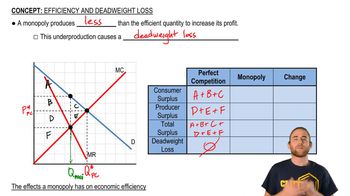
 12:19
12:19