Multiplier Effect of Investment Spending quiz #1 Flashcards

Multiplier Effect of Investment Spending quiz #1
Control buttons has been changed to "navigation" mode.
1/10
  • In which type of discretionary fiscal policy does the multiplier effect play a role?
    The multiplier effect plays a role in expansionary discretionary fiscal policy, such as when the government increases investment spending or government purchases to boost aggregate demand. The initial increase in spending leads to further rounds of increased income and consumption, amplifying the total impact on GDP.
  • What happens to household income when firms increase their investment spending?
    Household income increases because firms hire new workers or pay more, distributing the extra investment as income to households.
  • How does the marginal propensity to consume (MPC) affect the size of the multiplier?
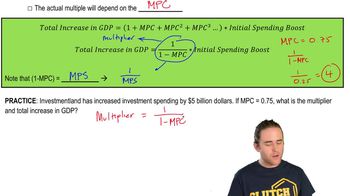
    A higher MPC results in a larger multiplier because more of each additional dollar of income is spent, leading to more rounds of spending.
  • What is the formula for calculating the multiplier using the marginal propensity to consume?
    The formula is 1 divided by (1 minus MPC), or 1/(1-MPC).
  • If the MPC is 0.75, what is the value of the multiplier?
    The multiplier is 4, since 1/(1-0.75) equals 1/0.25, which is 4.
  • How can the multiplier also be expressed using the marginal propensity to save (MPS)?
    The multiplier can be written as 1/MPS, since MPS equals 1 minus MPC.
  • What does each round of spending in the multiplier process depend on?
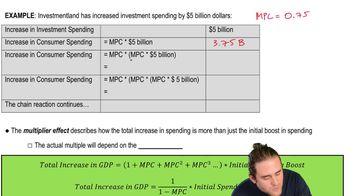
    Each round depends on the marginal propensity to consume, as only a portion of new income is spent in each round.
  • What is the total increase in GDP if the initial investment is $5 billion and the multiplier is 4?
    The total increase in GDP would be $20 billion, since $5 billion times 4 equals $20 billion.
  • Why does the multiplier effect result in a total increase in spending greater than the initial investment?
    Because each round of spending generates additional income and consumption, creating a chain reaction that amplifies the initial investment.
  • What happens to the multiplier if the MPC decreases?
    The multiplier becomes smaller, since a lower MPC means less of each additional dollar is spent, reducing the chain reaction of spending.