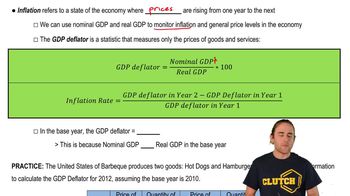
Nominal GDP measures the value of final goods and services using current year prices, while real GDP uses constant prices from a base year to account for inflation and focus on changes in production quantity.
What is true of real GDP compared to nominal GDP?
Real GDP holds prices constant by using base year prices, making it a better measure of changes in production over time compared to nominal GDP.
When is GDP roughly the same as GNP?
GDP is roughly the same as GNP when a country's income from abroad is similar to the income paid to foreign factors, but this is not the focus of nominal and real GDP calculations.
Which gross domestic product measure uses current dollars?
Nominal GDP uses current dollars, meaning it is calculated using the prices of goods and services in the current year.
GDP measured using base year prices is called what?
GDP measured using base year prices is called real GDP.
Nominal GDP is the market value of what?
Nominal GDP is the market value of all final goods and services produced within a country in a given period, measured using current year prices.
Real GDP refers to what?
Real GDP refers to the value of final goods and services produced, measured using constant prices from a base year to remove the effects of inflation.
Why is GDP not a perfect measure of well-being? For example,
GDP does not account for non-market activities, environmental quality, income distribution, or leisure, so it may not fully reflect a country's well-being.
What is the formula for calculating the value of a single good when computing nominal or real GDP?
Multiply the quantity of the good by its price; use current year prices for nominal GDP and base year prices for real GDP.
Why does the GDP deflator equal 100 in the base year?
In the base year, both nominal and real GDP use the same prices, so their ratio is 1, and multiplying by 100 gives a GDP deflator of 100.
What is the difference between nominal GDP and real GDP?
Nominal GDP measures the value of final goods and services using current year prices, while real GDP uses constant prices from a base year to account for inflation and focus on changes in production quantity.
How does nominal GDP differ from real GDP?
Nominal GDP is calculated with current prices, whereas real GDP is calculated with base year prices to remove the effects of inflation.
Why do economists prefer real GDP over nominal GDP when comparing economic output across years?
Economists prefer real GDP because it holds prices constant, allowing for a more accurate comparison of changes in production quantity over time by removing the effects of inflation.
What is the formula for calculating nominal GDP in a simple economy?
Nominal GDP is calculated by multiplying the quantity of each good produced by its current year price and summing the results for all goods.
How is real GDP calculated?
Real GDP is calculated by multiplying the quantity of each good produced in the current year by the price of that good in a chosen base year, then summing the results for all goods.
What does the GDP deflator measure?
The GDP deflator measures the overall level of prices in the economy by dividing nominal GDP by real GDP and multiplying by 100; it is used to monitor inflation.
How do you calculate the GDP deflator?
GDP deflator = (Nominal GDP / Real GDP) × 100.
What does it mean if the GDP deflator is greater than 100?
A GDP deflator greater than 100 indicates that the overall price level has increased since the base year, reflecting inflation.
How do you calculate the inflation rate using the GDP deflator?
Inflation rate = (New GDP deflator - Old GDP deflator) / Old GDP deflator.
Why is the GDP deflator always 100 in the base year?
In the base year, nominal GDP and real GDP are equal because both use base year prices, so the GDP deflator equals 100.
If nominal GDP rises, what can we conclude?
If nominal GDP rises, it could be due to an increase in production, an increase in prices (inflation), or both.
What is real GDP?
Real GDP is the value of final goods and services produced in an economy, measured using constant prices from a base year to account for inflation.
How is real GDP different from nominal GDP?
Real GDP uses base year prices to remove the effects of inflation, while nominal GDP uses current year prices and does not adjust for inflation.
What is the main advantage of using real GDP instead of nominal GDP?
The main advantage is that real GDP allows for accurate comparisons of economic output over time by removing the effects of changing prices.
What is the general formula for calculating the percentage change in real GDP between two years?
Percentage change in real GDP = (Real GDP in later year - Real GDP in earlier year) / Real GDP in earlier year.
Why don't economists use nominal GDP to compare economic output over time?
Economists avoid using nominal GDP for comparisons over time because it is affected by changes in prices (inflation), which can distort the true change in production.
What is meant by 'base year' in the context of real GDP?
The base year is a chosen year whose prices are used as a constant reference to calculate real GDP in all other years.
What does a change in real GDP indicate?
A change in real GDP indicates a change in the quantity of goods and services produced, holding prices constant.
What is the expenditures approach to calculating GDP?
The expenditures approach calculates GDP as the sum of consumption, investment, government purchases, and net exports.
How does inflation affect nominal GDP?
Inflation increases nominal GDP because it raises the prices of goods and services, even if the quantity produced does not change.
What is the purpose of using chain-weighted prices in GDP calculations?
Chain-weighted prices are used to adjust for changes in relative prices over time, providing a more accurate measure of real GDP, though this method is beyond the scope of introductory courses.
What does it mean if real GDP increases while nominal GDP remains constant?
If real GDP increases while nominal GDP remains constant, it suggests that the quantity of goods and services produced has increased, but prices have decreased.
 Back
Back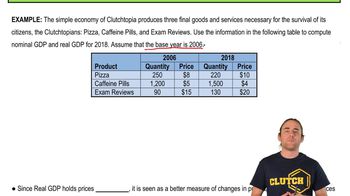
 09:15
09:15