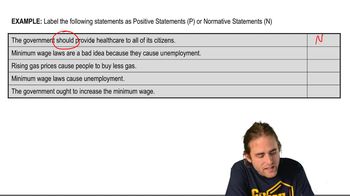
Which of the following statements is a normative macroeconomics statement?
A normative macroeconomics statement expresses an opinion about how the economy ought to be, often using words like 'should' or 'ought to.' For example, 'The government should increase spending to reduce unemployment' is a normative statement because it reflects a value judgment about economic policy.
What is the main characteristic that distinguishes a positive statement from a normative statement?
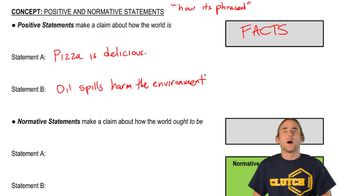
A positive statement describes how the world is and is phrased as a fact, while a normative statement expresses an opinion about how the world ought to be.
Can a positive statement be false, and if so, why?
Yes, a positive statement can be false because what matters is how it is phrased—as a factual claim—not whether it is actually true.
What are some keywords that often indicate a normative statement?
Keywords like 'should,' 'ought to,' 'good idea,' or 'bad idea' often signal a normative statement.
Why is the phrase 'the Moon is made of cheese' considered a positive statement?
It is considered a positive statement because it makes a factual claim about the world, regardless of its truth.
How can positive statements be evaluated or tested?
Positive statements can be tested and verified through observation or scientific methods to determine if they are true or false.
What type of statement is 'oil spills harm the environment' and why?
'Oil spills harm the environment' is a positive statement because it asserts a fact about the world without expressing an opinion.
What does a normative statement typically reflect about the speaker?
A normative statement reflects the speaker's values, opinions, or beliefs about how things should be.
How does the phrasing of a statement help determine if it is positive or normative?
The phrasing reveals whether the statement is presenting a fact (positive) or expressing an opinion or value judgment (normative).
Give an example of a normative statement related to environmental policy.
An example is 'Oil drilling ought to be illegal,' which expresses an opinion about what should happen.