Skip to main content
Macroeconomics
My Course
Learn
Exam Prep
AI Tutor
Study Guides
Flashcards
Explore
Try the app
My Course
Learn
Exam Prep
AI Tutor
Study Guides
Flashcards
Explore
Try the app
Back
PPF - Comparative Advantage and Absolute Advantage definitions
You can tap to flip the card.
Production Possibilities Frontier
You can tap to flip the card.
👆
Production Possibilities Frontier
A curve showing all possible combinations of two goods that can be produced with fixed resources and technology.
Track progress
Control buttons has been changed to "navigation" mode.
1/14
Related flashcards
Related practice
Recommended videos
PPF - Comparative Advantage and Absolute Advantage quiz
PPF - Comparative Advantage and Absolute Advantage
15 Terms
PPF - Comparative Advantage and Absolute Advantage
2. Introductory Economic Models
10 problems
Topic
PPF - Comparative Advantage and Trade
2. Introductory Economic Models
10 problems
Topic
2. Introductory Economic Models
6 topics
15 problems
Chapter
Guided course
04:36
Opportunity Costs and Comparative Advantage
2046
views
33
rank
Guided course
02:03
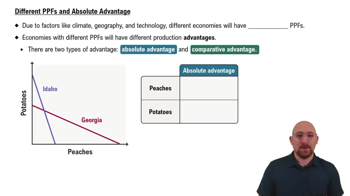
Different PPFs and Absolute Advantage
2420
views
30
rank
Terms in this set (14)
Hide definitions
Production Possibilities Frontier
A curve showing all possible combinations of two goods that can be produced with fixed resources and technology.
Absolute Advantage
The ability to produce more of a good using the same amount of resources compared to others.
Comparative Advantage
The ability to produce a good at a lower opportunity cost than others, guiding specialization and trade.
Opportunity Cost
The value of the next best alternative forgone when a choice is made, crucial for determining comparative advantage.
Specialization
Focusing resources on producing goods with the lowest opportunity cost to maximize efficiency and gains from trade.
Efficiency
A state where resources are allocated to maximize output, with no way to produce more of one good without less of another.
Aggregate Supply
The total output of goods and services an economy can produce when resources are fully employed.
Resource Allocation
The process of distributing available inputs among different uses to optimize production and trade.
Linear PPF
A straight-line production possibilities curve, indicating constant opportunity costs between two goods.
Productivity
The measure of output produced per unit of input, influencing both absolute and comparative advantage.
Trade
The voluntary exchange of goods or services, allowing parties to benefit from specialization and comparative advantage.
Economic Model
A simplified representation of reality used to analyze production, trade, and resource allocation.
Fixed Resources
Inputs that remain unchanged in quantity or quality during the analysis of production possibilities.
Fixed Technology
A condition where the methods and tools for production do not change during the analysis period.
 BackBack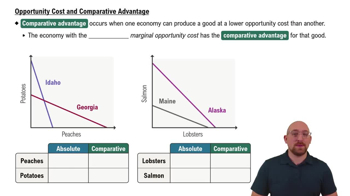
 04:36
04:36