Skip to main content
Macroeconomics
My Course
Learn
Exam Prep
AI Tutor
Study Guides
Flashcards
Explore
Try the app
My Course
Learn
Exam Prep
AI Tutor
Study Guides
Flashcards
Explore
Try the app
Back
PPF - Comparative Advantage and Trade definitions
You can tap to flip the card.
Comparative Advantage
You can tap to flip the card.
👆
Comparative Advantage
Lower opportunity cost in producing a good compared to others, enabling more efficient specialization and trade.
Track progress
Control buttons has been changed to "navigation" mode.
1/15
Related flashcards
Related practice
Recommended videos
PPF - Comparative Advantage and Trade quiz
PPF - Comparative Advantage and Trade
15 Terms
PPF - Comparative Advantage and Trade
2. Introductory Economic Models
10 problems
Topic
PPF - Price of the Trade
2. Introductory Economic Models
10 problems
Topic
2. Introductory Economic Models
6 topics
15 problems
Chapter
Guided course
05:30
Comparative Advantage and Specialization in Trade
711
views
20
rank
Terms in this set (15)
Hide definitions
Comparative Advantage
Lower opportunity cost in producing a good compared to others, enabling more efficient specialization and trade.
Absolute Advantage
Ability to produce more of a good with the same resources than another economy, regardless of opportunity cost.
Specialization
Concentration of resources on a limited range of goods to maximize efficiency and output.
Trade
Exchange of goods between economies, allowing access to a wider variety of products than produced alone.
Opportunity Cost
Value of the next best alternative forgone when choosing to produce one good over another.
Production Possibility Frontier
Curve showing the maximum combinations of goods an economy can produce with available resources.
Consumption Possibilities
Range of goods an economy can consume, which expands beyond its production limits through trade.
Aggregate Supply
Total output of goods available in an economy, which can increase with efficient specialization and trade.
Resource Allocation
Distribution of inputs among different uses to maximize output and efficiency.
Efficiency
Optimal use of resources to achieve the highest possible output with minimal waste.
International Trade
Exchange of goods and services across national borders, driven by differences in comparative advantage.
Output
Total quantity of goods produced by an economy, which can rise with specialization and trade.
Market
System or environment where buyers and sellers interact to exchange goods and services.
Goods
Physical items produced and exchanged in an economy, such as ravioli, pierogi, or wine.
Economy
System of production, distribution, and consumption of goods and services within a region or country.
 BackBack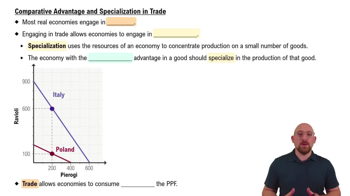
 05:30
05:30