Skip to main content
Macroeconomics
My Course
Learn
Exam Prep
AI Tutor
Study Guides
Flashcards
Explore
Try the app
My Course
Learn
Exam Prep
AI Tutor
Study Guides
Flashcards
Explore
Try the app
Back
PPF - Growth Analysis definitions
You can tap to flip the card.
Production Possibilities Frontier
You can tap to flip the card.
👆
Production Possibilities Frontier
A curve illustrating the maximum combinations of capital and consumer goods an economy can produce with available resources.
Track progress
Control buttons has been changed to "navigation" mode.
1/13
Related flashcards
Related practice
Recommended videos
PPF - Growth Analysis quiz
PPF - Growth Analysis
15 Terms
PPF - Growth Analysis
12. Productivity and Economic Growth
10 problems
Topic
Business Cycles and Their Characteristics
12. Productivity and Economic Growth
10 problems
Topic
13. Productivity and Economic Growth
6 topics
14 problems
Chapter
Guided course
06:58
Production Possibilities Frontier:Economic Growth Analysis
1782
views
39
rank
Terms in this set (13)
Hide definitions
Production Possibilities Frontier
A curve illustrating the maximum combinations of capital and consumer goods an economy can produce with available resources.
Economic Growth
An outward shift of the curve, reflecting increased capacity to produce goods and services in an economy.
Capital Goods
Items like factories and machinery used to produce other goods, contributing to future productivity.
Consumer Goods
Products intended for direct use by households, such as food or clothing.
Natural Resources
Inputs from the environment, such as oil or minerals, that can expand production potential when increased.
Human Resources
The labor force, whose education and productivity levels influence an economy’s output capacity.
Potential GDP
The highest output level an economy can sustain using all resources efficiently.
Supply Factors
Elements like resource availability, capital, and technology that expand an economy’s productive capacity.
Demand Factors
Household, business, and government purchases that must keep pace with increased output to avoid excess inventory.
Productive Efficiency
Resource use that minimizes cost, ensuring maximum output from given inputs.
Allocative Efficiency
Resource allocation that matches production with what citizens most desire, maximizing societal well-being.
Technology
Advancements that make capital and labor more productive, enabling higher output with the same resources.
Inventory
Unsold goods that accumulate when production exceeds demand, signaling underutilized capacity.
 BackBack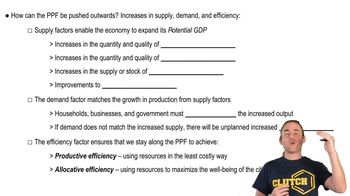
 06:58
06:58