A repeated game is a situation where the same strategic interaction is played multiple times, allowing players to adjust their strategies based on past outcomes.
How does a repeated game differ from a one-time game?
In a repeated game, players interact multiple times, which allows for strategies based on previous actions, unlike a one-time game where decisions are made only once.
Why are repeated games considered more realistic in economic scenarios?
Repeated games reflect ongoing interactions, such as firms making production decisions over time, which is common in real-life economic situations.
What is the tit for tat strategy in repeated games?
Tit for tat is a strategy where a player mimics the opponent's previous action, cooperating if the opponent cooperated and cheating if the opponent cheated.
How does the tit for tat strategy promote cooperation?
It encourages cooperation by rewarding cooperative behavior and punishing cheating, making mutual cooperation more attractive over time.
What is the trigger strategy in repeated games?
The trigger strategy involves cooperating until the opponent cheats once, after which the player cheats forever as punishment.
How does the trigger strategy differ from tit for tat?
Unlike tit for tat, which responds to each action, the trigger strategy permanently shifts to cheating after a single defection by the opponent.
Why might players in repeated games aim for a collaborative agreement?
Collaboration can yield higher joint payoffs over time compared to the lower payoffs from mutual cheating.
How do repeated games relate to aggregate demand and supply in economics?
Repeated games model ongoing decisions that affect aggregate demand and supply, highlighting the importance of sustained cooperation for better outcomes.
What role does credibility play in maintaining cooperation in repeated games?
Credibility ensures that threats of punishment for cheating are believable, which helps sustain cooperative equilibria.
What happens if a player cheats in a trigger strategy?
If a player cheats, the other player will cheat in all future rounds, ending any possibility of future cooperation.
How does the tit for tat strategy respond to a single instance of cheating?
Tit for tat responds by cheating in the next round but will return to cooperation if the opponent does so.
Why is interdependence more significant in repeated games?
Because players' current actions can affect future payoffs, making their decisions more interconnected over time.
What is the main advantage of cooperation in repeated games?
Cooperation can lead to higher long-term payoffs for all players compared to repeated mutual defection.
How do repeated games enhance our understanding of economic behavior?
They show how ongoing interactions and strategic responses can influence outcomes like responses to demand shocks and the maintenance of cooperation.
 Back
Back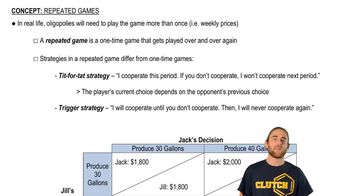
 02:28
02:28