In macroeconomics, unemployment is an example of which type of risk?
Unemployment is an example of financial risk, as it represents uncertainty about future financial losses due to unpredictable events.
What psychological tendency explains why most people avoid taking risky bets even when the potential gain equals the potential loss?
Most people are risk-averse, meaning they dislike risk because the pain of losing is greater than the pleasure of gaining the same amount. This leads them to avoid risky bets even if the expected value is neutral.
How does the law of diminishing returns relate to marginal utility in the context of consuming goods?
The law of diminishing returns states that each additional unit of a good provides less additional satisfaction, or marginal utility, than the previous one. This means the first units consumed give the most happiness, while later units add less.
Why does losing a certain amount of money cause a greater change in utility than gaining the same amount?
Losing money causes a larger drop in utility because the initial units of money are more valuable for basic needs and happiness. Gaining the same amount adds less utility due to diminishing marginal utility.
What is the main purpose of insurance in the context of risk and utility?
Insurance allows individuals to pay a small, predictable cost to avoid the possibility of a large, catastrophic loss. This helps maintain a more stable level of utility by reducing the risk of significant negative events.
How do economists use the concept of utility to analyze decisions under risk?
Economists use utility to quantify the satisfaction or happiness people derive from different outcomes. This helps explain why people may avoid risky choices that could lead to large losses in utility.
What type of events do people typically insure against, according to the transcript?
People typically insure against unlikely but catastrophic events, such as a fire. These events are rare but would cause significant financial and utility loss if they occurred.
How does paying an insurance premium affect a person's overall satisfaction or utility?
Paying an insurance premium slightly reduces a person's utility because it is a certain cost. However, it prevents a much larger potential loss in utility from a catastrophic event.
What does a utility graph typically show when plotting money on the x-axis?
A utility graph shows that the first units of money provide the most utility, and additional money adds less and less utility. This illustrates diminishing marginal utility as wealth increases.
Why might someone choose to pay for insurance even if the event being insured against is unlikely?
Someone might pay for insurance because the potential loss from the unlikely event would cause a huge drop in utility. The small, certain cost of insurance is preferable to risking a large, uncertain loss.
 Back
Back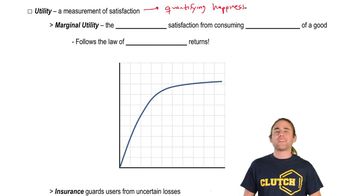
 07:25
07:25