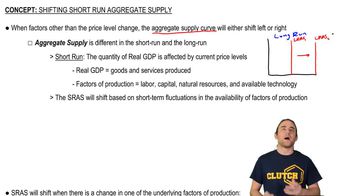
Which of the following events would cause the short-run aggregate supply (SRAS) curve to shift to the right?
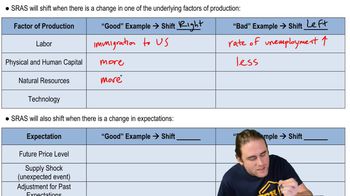
An increase in the availability of labor, improvements in technology, discovery of new natural resources, or positive expectations about future price levels would cause the SRAS curve to shift to the right.
Which of the following events would cause short-run aggregate supply (SRAS) to decrease?
A decrease in available labor, loss of physical or human capital, depletion of natural resources, negative supply shocks, or expectations of lower future price levels would cause SRAS to decrease (shift to the left).
How does an increase in the natural rate of unemployment affect short-run aggregate supply?
An increase in the natural rate of unemployment reduces the available labor, causing the short-run aggregate supply curve to shift to the left.
What impact does an unexpected discovery of a key resource have on short-run aggregate supply?
An unexpected discovery of a key resource acts as a positive supply shock, shifting the short-run aggregate supply curve to the right.
How do adjustments for past expectations about price levels influence the SRAS curve?
If past expectations about price levels were inaccurate, firms adjust production in the current period, causing the SRAS curve to shift to correct for previous errors.
Why does an increase in physical or human capital shift the SRAS curve to the right?
More physical or human capital increases productive capacity, allowing firms to produce more goods and services at every price level.
What is the effect of negative supply shocks on the short-run aggregate supply curve?
Negative supply shocks, such as the loss of a key resource, immediately decrease resource availability and shift the SRAS curve to the left.
How do expectations of higher future price levels affect firm production in the short run?
Firms anticipating higher future price levels increase production to take advantage of expected higher profits, shifting SRAS to the right.
What role does technology play in shifting the short-run aggregate supply curve?
Advancements in technology generally increase efficiency and output, causing the SRAS curve to shift to the right.
How does immigration affect the short-run aggregate supply curve?
Immigration increases the labor force, which boosts productive capacity and shifts the SRAS curve to the right.