Which of the following factors causes the short-run aggregate supply (SRAS) curve to shift to the right?
The SRAS curve shifts to the right when there is an increase in factors that lower production costs or improve productivity, such as a decrease in input prices (like wages or raw materials), technological advancements, or an increase in available labor or capital. These changes enable firms to produce more goods and services at every price level.
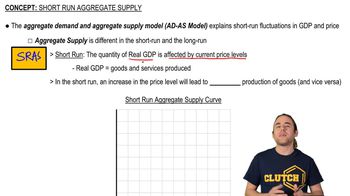
What does the upward slope of the short-run aggregate supply (SRAS) curve indicate about the relationship between price level and real GDP?
It indicates that as the price level increases, the quantity of goods and services produced (real GDP) also increases in the short run.
How does the SRAS curve differ in shape from the long-run aggregate supply (LRAS) curve?
The SRAS curve is upward sloping, while the LRAS curve is vertical, reflecting that output in the long run is not affected by price levels.
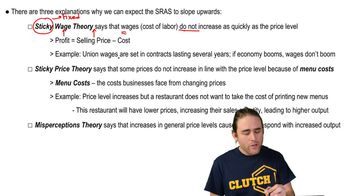
According to sticky wage theory, why do firms increase production when the price level rises?
Firms increase production because wages are slow to adjust, so higher prices lead to higher profits, incentivizing more output.
What is the main reason wages are considered 'sticky' in the sticky wage theory?
Wages are often set by contracts or negotiations, such as union agreements, and do not adjust quickly to changes in the price level.
What are menu costs, and how do they relate to the sticky price theory?
Menu costs are the expenses businesses face when changing prices, such as printing new menus, which can cause some firms to delay price increases.
How does the sticky price theory explain increased output for firms that do not raise their prices as quickly as the overall price level?
Firms with slower price increases attract more customers due to relatively lower prices, leading to higher sales and increased production.
What does the misperceptions theory suggest about how firms interpret rising price levels?
It suggests that firms may mistakenly interpret higher prices as a signal of increased demand for their products, prompting them to raise output.
In the context of SRAS, what is meant by 'real GDP'?
Real GDP refers to the total quantity of goods and services produced in the economy, adjusted for changes in the price level.
Why might the SRAS curve shift to the left?
The SRAS curve shifts to the left when production costs rise, such as through higher input prices or decreased productivity, reducing the amount firms are willing to supply at each price level.