Skip to main content
Macroeconomics
My Course
Learn
Exam Prep
AI Tutor
Study Guides
Flashcards
Explore
Try the app
My Course
Learn
Exam Prep
AI Tutor
Study Guides
Flashcards
Explore
Try the app
Back
Short Run Phillips Curve definitions
You can tap to flip the card.
Phillips Curve
You can tap to flip the card.
👆
Phillips Curve
A graphical tool showing the trade-off between inflation and unemployment, typically with a downward slope indicating their inverse relationship.
Track progress
Control buttons has been changed to "navigation" mode.
1/15
Related flashcards
Related practice
Recommended videos
Short Run Phillips Curve quiz #1
Short Run Phillips Curve
11 Terms
Short Run Phillips Curve
20. Tradeoffs Between Inflation and Unemployment
10 problems
Topic
Long Run Phillips Curve
20. Tradeoffs Between Inflation and Unemployment
10 problems
Topic
21. Revisiting Inflation, Unemployment, and Policy
6 topics
15 problems
Chapter
Guided course
09:33
Short Run Phillips Curve
2019
views
45
rank
Terms in this set (15)
Hide definitions
Phillips Curve
A graphical tool showing the trade-off between inflation and unemployment, typically with a downward slope indicating their inverse relationship.
Inverse Relationship
A situation where one variable rises as the other falls, such as inflation increasing while unemployment decreases.
Aggregate Demand
The total demand for goods and services in an economy at a given overall price level and time.
Aggregate Supply
The total output of goods and services that firms in an economy are willing to produce at a given price level.
Equilibrium
A point where aggregate demand equals aggregate supply, determining the economy's price level and output.
GDP
The total market value of all final goods and services produced within a country in a specific period.
Price Level
A measure reflecting the average prices of goods and services in an economy, used to track inflation.
Inflation
A sustained increase in the general price level, often measured as a percentage change from one year to the next.
Unemployment
The percentage of the labor force that is not employed but actively seeking work.
Short Run Phillips Curve
A curve illustrating the temporary inverse relationship between inflation and unemployment in the short term.
Trade-off
A situation where achieving lower values for one variable, like unemployment, results in higher values for another, like inflation.
Employment
The condition of having paid work, which increases as GDP rises due to higher aggregate demand.
Base Year
A reference period used for comparison in economic measurements, such as price levels or inflation rates.
Output
The total quantity of goods and services produced, closely linked to employment and GDP.
Axes
The horizontal and vertical lines on a graph, here representing unemployment rate and inflation rate on the Phillips curve.
 BackBack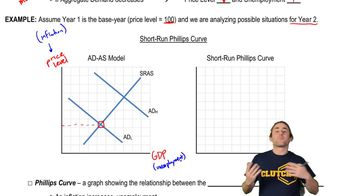
 09:33
09:33