Household production and underground economy transactions are not counted as part of GDP, while government spending on public goods is included.
What are some shortcomings of GDP as a measure of economic well-being?
Both are shortcomings of GDP. GDP fails to account for income distribution and excludes household production, making it an imperfect measure of economic well-being.
Why might GDP be understated?
GDP may be understated because it does not include household production or underground economy activities, both of which contribute to actual economic output.
How does the entry of homemakers into the workforce affect GDP calculations over time?
When homemakers enter the workforce, their production becomes included in GDP, which can cause a sudden increase in measured GDP even though they were producing value before as well.
Why is the value of leisure not reflected in GDP, and what implication does this have for measuring well-being?
GDP does not account for leisure time, so increases in GDP from more work do not necessarily mean greater happiness or well-being for citizens.
What impact do environmental regulations have on GDP and citizen well-being?
Environmental regulations may lower GDP by restricting production, but they can improve citizen well-being by reducing pollution and health hazards.
How can increased crime affect GDP figures, and why might this be misleading?
Increased crime can raise GDP through higher government spending on law enforcement, but this does not necessarily improve the quality of life for citizens.
What does GDP per capita measure, and what are its limitations?
GDP per capita measures average output per person, but it does not account for factors like leisure, environmental quality, or income distribution.
Why are transactions in the underground economy excluded from GDP, and what types of activities does this include?
Underground economy transactions are excluded because they are hidden from government oversight, including illegal trade, tax evasion, and unreported sales.
How does GDP measure the 'size of the pie' but not the 'distribution of slices' among citizens?
GDP shows total production in an economy but does not indicate how that output is divided among individuals, so it can mask inequalities in income and well-being.
Why is GDP not a perfect measure of well-being?
GDP does not account for factors such as income distribution, leisure time, environmental quality, household production, underground economic activity, or social well-being, making it an imperfect measure of overall well-being.
What is one of the main flaws of using GDP as a measure of economic activity?
One main flaw is that GDP excludes household production and underground economic activity, which both contribute to the economy but are not captured in official GDP statistics.
What important aspects of well-being are not adequately measured by real GDP per capita?
Real GDP per capita does not adequately measure leisure time, environmental quality, income distribution, or non-economic aspects of well-being such as social cohesion and safety.
What types of economic activities are not included in GDP calculations?
GDP does not include household production, underground economic activity (such as illegal trade and tax evasion), and non-market transactions.
What does GDP per capita fail to show about a country's population?
GDP per capita fails to show the distribution of income among citizens, the value of leisure, environmental quality, and other non-economic aspects of well-being.
Which types of production or transactions are not counted in GDP?
Non-market production (like homemaking or self-produced goods), underground economic activity, and illegal transactions are not counted in GDP.
What are some key factors that GDP does not account for when measuring a country's economic performance?
GDP does not account for income inequality, leisure time, environmental impacts, household production, underground economy, or social well-being.
 Back
Back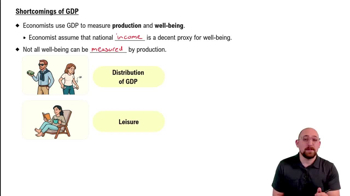
 02:21
02:21