Skip to main content
Macroeconomics
My Course
Learn
Exam Prep
AI Tutor
Study Guides
Flashcards
Explore
Try the app
My Course
Learn
Exam Prep
AI Tutor
Study Guides
Flashcards
Explore
Try the app
Back
Solutions to Informational Problems definitions
You can tap to flip the card.
Information Asymmetry
You can tap to flip the card.
👆
Information Asymmetry
A situation where one party in a transaction possesses more or better information than the other, often leading to inefficient outcomes.
Track progress
Control buttons has been changed to "navigation" mode.
1/15
Related flashcards
Recommended videos
Solutions to Informational Problems quiz
Solutions to Informational Problems
15 Terms
Guided course
03:06
Solutions to Informational Problems:Signaling
4
views
Guided course
05:57
Solutions to Informational Problems:Screening
4
views
Terms in this set (15)
Hide definitions
Information Asymmetry
A situation where one party in a transaction possesses more or better information than the other, often leading to inefficient outcomes.
Adverse Selection
A problem arising when one side of a market cannot distinguish between high and low quality participants before a transaction.
Moral Hazard
A risk that one party may change behavior after a deal, knowing they are protected from consequences, such as slacking off at work.
Signaling
An action by the informed party to reveal private information, like offering a warranty or displaying a college degree.
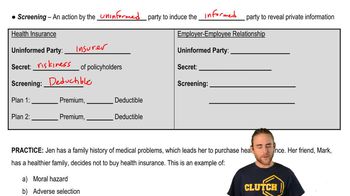
Screening
A strategy by the uninformed party to induce the other side to reveal private information, such as offering different insurance plans.
Warranty
A promise to repair or replace a product, used to assure buyers of quality and reduce doubts about hidden defects.
Deductible
An out-of-pocket cost in insurance that separates riskier individuals from less risky ones based on their plan choices.
Premium
A regular payment for insurance coverage, often balanced with deductibles to attract different risk groups.
Commission-Based Pay
A compensation method where earnings depend on performance, used to motivate effort and discourage slacking.
Year-End Bonus
An additional payment awarded for strong performance, serving as an incentive to maintain high effort throughout the year.
Shirking
A term for slacking off or avoiding work responsibilities, often a concern in employer-employee relationships.
Lemon
A term for a low-quality product, especially a used car with hidden defects, central to discussions of information problems.
Market Efficiency
A state where resources are allocated optimally, often hindered by information gaps but improved by signaling and screening.
Incentive
A factor motivating parties to act in certain ways, such as working harder for bonuses or commissions.
Risk
The likelihood of an uncertain event, such as illness or poor job performance, influencing insurance and employment contracts.
 BackBack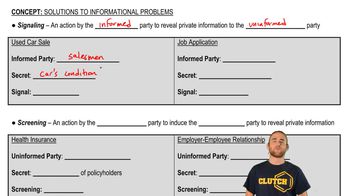
 03:06
03:06