A government subsidy is a financial benefit given to market participants, acting as a reverse tax and increasing the quantity traded beyond equilibrium.
How does a subsidy affect the equilibrium quantity in a market?
A subsidy causes the quantity traded to increase past the equilibrium, resulting in overtrading.
What is the main similarity between the effects of a subsidy and a tax?
Both subsidies and taxes create two different prices for buyers and sellers and result in deadweight loss, but subsidies cause overtrading while taxes cause undertrading.
How does a subsidy shift the demand or supply curve?
A subsidy shifts the demand or supply curve to the right by the amount of the subsidy.
Who receives the full benefit of a subsidy: the consumer or the producer?
Neither party receives the full benefit; the subsidy is split between consumers and producers based on the elasticity of supply and demand.
How is the benefit of a subsidy divided between consumers and producers?
The division depends on the price elasticity of demand and supply; the more inelastic party receives a larger portion of the subsidy benefit.
What happens to the price paid by buyers and the price received by sellers when a subsidy is introduced?
The price buyers pay is lower than the price sellers receive, with the government filling the gap through the subsidy.
What is deadweight loss in the context of subsidies?
Deadweight loss occurs because subsidies lead to overtrading, using resources inefficiently beyond the equilibrium quantity.
How does the elasticity of demand affect who benefits more from a subsidy?
If demand is more inelastic, consumers receive a larger share of the subsidy benefit.
How does the elasticity of supply affect who benefits more from a subsidy?
If supply is more inelastic, suppliers receive a larger share of the subsidy benefit.
What is the graphical representation of subsidy benefit distribution with elastic supply and inelastic demand?
Consumers gain more from the subsidy when demand is inelastic and supply is elastic, as shown by the larger area under the demand curve.
What is the graphical representation of subsidy benefit distribution with inelastic supply and elastic demand?
Suppliers gain more from the subsidy when supply is inelastic and demand is elastic, as shown by the larger area above the supply curve.
How does the subsidy effect compare to the tax effect regarding benefit and burden distribution?
Both subsidies and taxes distribute their effects based on elasticity; the more inelastic party bears more tax burden and receives more subsidy benefit.
What happens to market prices when a subsidy is applied?
The price sellers receive increases, and the price buyers pay decreases, with the government covering the difference.
Why does a subsidy cause overtrading in a market?
A subsidy encourages trading beyond the equilibrium quantity, leading to inefficient allocation of resources and deadweight loss.
 Back
Back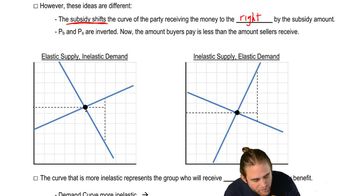
 09:29
09:29