Supply and Demand Together: Equilibrium, Shortage, and Surplus quiz #1 Flashcards

Supply and Demand Together: Equilibrium, Shortage, and Surplus quiz #1
Control buttons has been changed to "navigation" mode.
1/10
  • Which of the following changes would cause the supply curve to shift to the right, resulting in an increase in quantity supplied at every price level?
    An increase in supply, such as improvements in technology, lower production costs, or more suppliers entering the market, would cause the supply curve to shift to the right. This means at every price, a greater quantity is supplied, which can lead to a lower equilibrium price and higher equilibrium quantity.
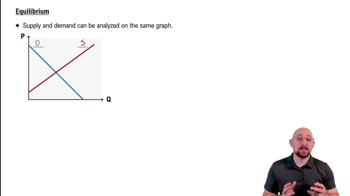
  • What is the graphical representation of market equilibrium in a supply and demand graph?
    Market equilibrium is represented by the intersection point of the supply and demand curves on the graph.
  • How are the equilibrium price and equilibrium quantity denoted in economic notation?
    The equilibrium price is denoted as P* and the equilibrium quantity as Q*.
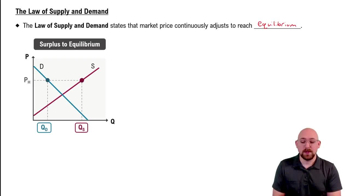
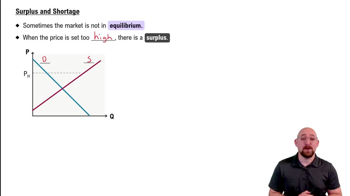
  • What happens to the market when the price is set above the equilibrium price?
    A surplus occurs, meaning quantity supplied exceeds quantity demanded, resulting in excess supply.
  • How can you identify equilibrium using a supply and demand schedule?
    Equilibrium is found where the quantity supplied equals the quantity demanded at a specific price in the schedule.
  • What is the result when the market price is set below the equilibrium price?
    A shortage occurs, where quantity demanded exceeds quantity supplied, indicating insufficient supply.
  • In the context of supply and demand, what does a shortage represent on a graph?
    A shortage is the difference between the higher quantity demanded and the lower quantity supplied at a price below equilibrium.
  • What does the law of supply and demand state about market prices?
    It states that market prices will adjust to correct surpluses and shortages, moving toward the equilibrium price.
  • If there is a surplus in the market, what typically happens to the price?
    The price tends to decrease as suppliers lower prices to sell excess goods, moving the market toward equilibrium.
  • What is the typical market response when there is a shortage of a good?
    Prices usually rise as buyers compete for the limited supply, encouraging suppliers to increase production and restoring equilibrium.