Skip to main content
Macroeconomics
My Course
Learn
Exam Prep
AI Tutor
Study Guides
Flashcards
Explore
Try the app
My Course
Learn
Exam Prep
AI Tutor
Study Guides
Flashcards
Explore
Try the app
Back
Tariffs quiz
You can tap to flip the card.
What is a tariff in the context of international trade?
You can tap to flip the card.
👆
What is a tariff in the context of international trade?
A tariff is a tax imposed on imported goods, making them more expensive compared to domestic products.
Track progress
Control buttons has been changed to "navigation" mode.
1/15
Related flashcards
Related practice
Recommended videos
Tariffs definitions
Tariffs
15 Terms
Tariffs on Imports
9. International Trade
10 problems
Topic
Import Quotas and VERs
9. International Trade
10 problems
Topic
9. International Trade
5 topics
14 problems
Chapter
Guided course
14:35
Tariffs on Imports
3435
views
48
rank
Terms in this set (15)
Hide definitions
What is a tariff in the context of international trade?
A tariff is a tax imposed on imported goods, making them more expensive compared to domestic products.
How do tariffs affect the price of imported goods in the domestic market?
Tariffs increase the price of imported goods by the amount of the tariff, making them more expensive for domestic consumers.
What happens to the quantity of imports when a tariff is imposed?
The quantity of imports decreases because the higher price reduces demand for imported goods.
How does a tariff impact domestic producers?
Domestic producers benefit from tariffs because the higher price allows them to supply more and compete better with foreign producers.
What is the effect of tariffs on consumer surplus?
Consumer surplus decreases because consumers pay higher prices and buy less of the good.
How does producer surplus change after a tariff is imposed?
Producer surplus increases because domestic producers can sell more at the higher price created by the tariff.
How is government revenue from tariffs calculated?
Government revenue from tariffs is calculated as the tariff rate multiplied by the quantity of imports.
Which area on the tariff graph represents government revenue?
Government revenue is represented by section E on the tariff graph.
What is deadweight loss in the context of tariffs?
Deadweight loss is the loss of economic efficiency and mutually beneficial trades that do not occur because of the tariff.
Which sections on the tariff graph represent deadweight loss?
Deadweight loss is represented by sections D and F, known as the 'bridge' of deadweight loss.
What are the two main purposes of tariffs?
The two main purposes are revenue tariffs, which generate government income, and protective tariffs, which help domestic industries compete.
What is a revenue tariff?
A revenue tariff is imposed mainly to generate tax revenue for the government from imports.
What is a protective tariff?
A protective tariff is designed to help domestic industries by making imported goods more expensive, thus reducing foreign competition.
How does a tariff affect total economic surplus?
Total economic surplus decreases by the amount of deadweight loss (D + F) after a tariff is imposed.
Why do domestic producers often support tariffs?
Domestic producers support tariffs because they raise the market price, allowing them to sell more and face less competition from cheaper imports.
 BackBack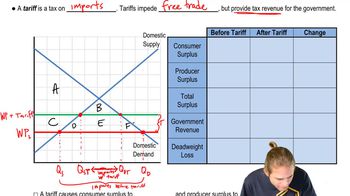
 14:35
14:35