What is an example of automatic fiscal policy in macroeconomics?
An example of automatic fiscal policy is the way tax revenues change with the business cycle: during economic booms, higher incomes lead to higher tax payments, reducing consumption, while during recessions, lower incomes result in lower tax payments, which helps boost consumption. This adjustment happens automatically without new government action and is known as an automatic stabilizer.
How does a decrease in taxes affect household disposable income?
A decrease in taxes increases household disposable income. This allows households to spend more on consumption and savings.
Why is the tax multiplier generally smaller than the government spending multiplier?
The tax multiplier is smaller because there is no initial direct boost in spending, only an increase in disposable income. Some of this extra income is saved rather than spent, reducing the overall effect.
What is the sign of the tax multiplier and why?
The tax multiplier is negative. This is because a decrease in taxes leads to an increase in income and consumption, showing an inverse relationship.
What happens to aggregate demand when taxes are decreased?
Aggregate demand increases when taxes are decreased. This is due to higher household consumption resulting from increased disposable income.
How do automatic stabilizers affect taxes during a recession?
During a recession, automatic stabilizers cause taxes to decrease as incomes fall. This helps boost consumption and partially offset the downturn.
Why are government purchases not considered automatic stabilizers?
Government purchases are not automatic stabilizers because they remain stable unless changed by discretionary policy. They do not automatically adjust with the business cycle.
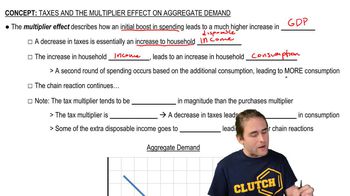
What is the chain reaction described by the multiplier effect when taxes are lowered?
When taxes are lowered, increased disposable income leads to higher consumption, which becomes income for others who then also spend more. This process repeats, amplifying the initial effect on GDP.
How does the amount of taxes collected change with GDP according to the automatic stabilizer concept?
As GDP increases, the amount of taxes collected also increases automatically. Conversely, when GDP decreases, tax collections fall without any policy change.
What equation is used to calculate the tax multiplier?
The tax multiplier is calculated as the change in equilibrium GDP divided by the change in taxes. The result is typically a negative number, reflecting the inverse relationship.
 Back
Back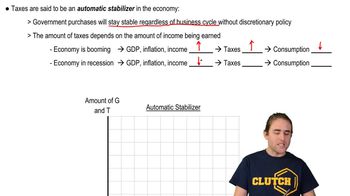
 03:50
03:50