Which function of money is most directly affected by inflation, and why?
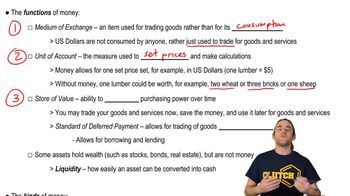
The store of value function of money is most directly affected by inflation because inflation erodes the purchasing power of money over time, making it less effective at retaining value for future use.
What is the definition of money as described in the lesson?
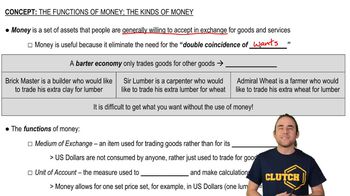
Money is a set of assets that people are generally willing to accept in exchange for goods and services. It acts as a medium in transactions between buyers and sellers.
Why does money eliminate the need for a double coincidence of wants?
Money allows people to trade goods and services without needing both parties to want what the other has. This makes transactions much simpler compared to barter economies.
How does money function as a unit of account in an economy?
Money provides a common measure for setting prices and making calculations. This eliminates the need for complex barter price comparisons between different goods.
What is meant by the liquidity of an asset?
Liquidity refers to how easily an asset can be converted into cash. Highly liquid assets can be quickly sold for cash, while less liquid assets take more time to sell.
Why are stocks and real estate not considered money even though they store value?
Stocks and real estate are not considered money because they cannot be used directly for everyday transactions. They lack the liquidity and universal acceptability that money has.
What distinguishes fiat money from commodity money?
Fiat money has value only because the government declares it as legal tender and it has no other uses. Commodity money has intrinsic value and can be used for purposes other than as a medium of exchange.
Give an example of commodity money and explain why it qualifies as such.
Gold is an example of commodity money because it is used as a medium of exchange and also has other uses, such as in jewelry and electronics. Its value is not solely based on government decree.
How does money facilitate the standard for deferred payment?
Money allows people to make agreements for future payments, such as loans, with the expectation that the money will retain its value. This enables transactions like buying a car on credit.
Why can't you use a house or a percentage of a house to buy groceries directly?
A house is not liquid enough to be used for everyday purchases because it cannot be easily divided or quickly sold for cash. Money, in contrast, is universally accepted and easily used for such transactions.
 Back
Back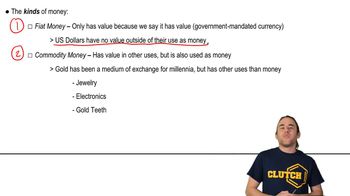
 01:33
01:33