Types of Unemployment quiz #1 Flashcards

Types of Unemployment quiz #1
Control buttons has been changed to "navigation" mode.
1/10
  • What are the three main types of unemployment, and how are they defined?
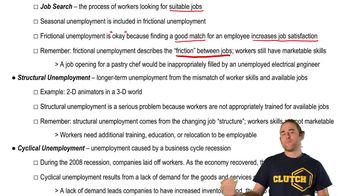
    The three main types of unemployment are frictional, structural, and cyclical. Frictional unemployment occurs when workers are between jobs or searching for new jobs and have marketable skills. Structural unemployment arises from a mismatch between workers' skills and available jobs, often due to technological changes, resulting in unmarketable skills. Cyclical unemployment is caused by downturns in the business cycle, such as recessions, and is due to reduced demand for goods and services.
  • What type of unemployment includes seasonal workers who are temporarily out of work?
    Seasonal unemployment is included under frictional unemployment, as it involves workers who are between jobs due to the end of a season.
  • Why is frictional unemployment considered acceptable in an economy?
    Frictional unemployment is considered acceptable because it reflects workers searching for jobs that better match their skills, leading to higher job satisfaction and productivity.
  • What causes structural unemployment to be a more serious problem than frictional unemployment?
    Structural unemployment is more serious because it results from workers having unmarketable skills that no longer match available jobs, often requiring retraining or relocation.
  • How does technological change contribute to structural unemployment?
    Technological change can make certain skills obsolete, leading to a mismatch between workers' abilities and the needs of employers, thus causing structural unemployment.
  • What happens to cyclical unemployment when the economy recovers from a recession?
    Cyclical unemployment decreases as the economy recovers, and companies rehire workers due to increased demand for goods and services.
  • At full employment, which types of unemployment are still present in the economy?
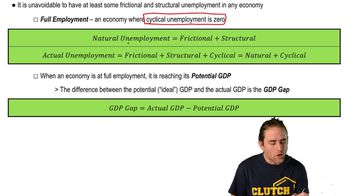
    At full employment, only frictional and structural unemployment remain; cyclical unemployment is zero.
  • What is the GDP gap, and how is it related to unemployment?
    The GDP gap is the difference between actual GDP and potential GDP, and it reflects the loss in output due to unemployment above the natural rate.
  • What is meant by 'natural unemployment'?
    Natural unemployment is the sum of frictional and structural unemployment, representing the unemployment that exists even when the economy is at full employment.
  • Why does actual unemployment include more than just natural unemployment?
    Actual unemployment includes frictional, structural, and cyclical unemployment, whereas natural unemployment only includes frictional and structural types.