How does inflation affect the purchasing power of money?
Inflation reduces the purchasing power of money because as prices rise, each unit of currency buys fewer goods and services than before.
Which statement best describes U.S. inflation between 1982 and 2000?
During this period, U.S. inflation was relatively low and stable, meaning price levels increased gradually and predictably.
Which scenario is most likely the result of inflation?
A retiree living on a fixed pension finds that their income buys fewer goods and services over time as prices rise.
What is the difference between anticipated and unanticipated inflation?
Anticipated inflation is expected and can be planned for, while unanticipated inflation occurs unexpectedly and can disrupt financial plans.
Why are landlords with fixed lease payments negatively affected by inflation?
Landlords with fixed lease payments are hurt because their rental income stays the same while prices rise, reducing the real value of their earnings.
How does inflation impact the real interest rate earned by savers?
Inflation reduces the real interest rate, meaning savers earn less in terms of purchasing power than the nominal interest rate suggests.
Why are people who hoard cash especially vulnerable to inflation?
People who hoard cash are vulnerable because their money does not earn interest and loses value as prices increase.
How do cost of living adjustments protect flexible income receivers from inflation?
Cost of living adjustments increase income in line with inflation, helping flexible income receivers maintain their purchasing power.
Why do debtors benefit from unanticipated inflation?
Debtors benefit because the money they repay is worth less in purchasing power, making it easier to pay back loans.
What happens to the real income of someone whose nominal income remains constant during inflation?
Their real income decreases because the same amount of money buys fewer goods and services as prices rise.
Why does high and unexpected inflation have a greater cost for certain groups in the economy?
High and unexpected inflation has a greater cost because it reduces the real value of fixed incomes, savings, and loan repayments, harming those who cannot adjust their income or assets to keep up with rising prices.
Who is less likely to be harmed by inflation?
People with flexible incomes, such as those with cost of living adjustments or Social Security payments, are less likely to be harmed by inflation because their income rises with prices.
What is an inflation tax?
An inflation tax is the loss of purchasing power experienced by holders of money when inflation reduces the real value of cash holdings.
Inflation does the greatest harm to money's function as a what?
Inflation does the greatest harm to money's function as a store of value.
Why are people with savings hurt by inflation?
People with savings are hurt by inflation because the real value of their saved money decreases as prices rise, reducing their purchasing power.
What is the inflation tax?
The inflation tax refers to the reduction in the real value of money held by the public due to rising prices caused by inflation.
The inflation tax falls most heavily on those who hold what?
The inflation tax falls most heavily on those who hold cash or non-interest-bearing money.
How can surprise inflation help people who have borrowed money?
Surprise inflation helps borrowers because they repay loans with money that has less purchasing power than when they borrowed it, effectively reducing the real value of their debt.
Who is least likely to be hurt by unanticipated inflation?
People with flexible incomes that adjust for inflation, such as those with cost of living adjustments, are least likely to be hurt by unanticipated inflation.
What may be a benefit of inflation?
A benefit of inflation is that it can reduce the real burden of debt for borrowers, making it easier to repay loans.
Who is most likely to benefit from inflation?
Debtors, or people who have borrowed money, are most likely to benefit from inflation because the real value of what they owe decreases.
Who is harmed by unexpected inflation?
Fixed income receivers, savers, and creditors are harmed by unexpected inflation because their income or assets do not keep up with rising prices.
What is an example of an inflation risk?
An example of an inflation risk is a creditor lending money at a fixed interest rate and then being repaid with money that has less purchasing power due to higher-than-expected inflation.
What is one effect of inflation on an economy?
One effect of inflation on an economy is the redistribution of wealth from savers and creditors to borrowers and debtors.
Why are people with savings hurt by inflation?
People with savings are hurt by inflation because the purchasing power of their saved money declines as prices increase.
Who is less likely to be harmed by inflation: a person with a fixed income or a person with a cost of living adjustment?
A person with a cost of living adjustment is less likely to be harmed by inflation because their income increases with rising prices.
 Back
Back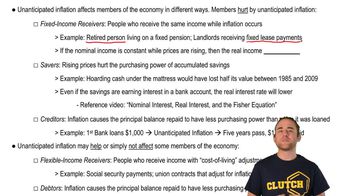
 05:58
05:58