 Back
BackMacro Chapter 2
 02:08
02:08
Terms in this set (20)
Scarcity occurs when resources are insufficient to satisfy all wants at a zero price. It means we never have enough of everything, including time, to satisfy every desire.
Scarcity is a permanent condition of limited resources, while a shortage is a temporary situation where demand exceeds supply at a given price.
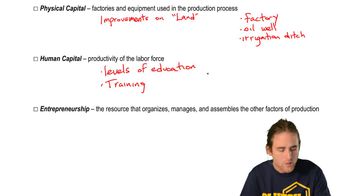
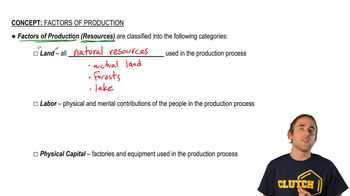
Land (natural resources), Labor (human resources), Physical capital (manufactured resources), and Human capital (education and training).
Opportunity cost is the highest-valued next-best alternative that must be sacrificed to obtain something.
The PPC shows all possible combinations of maximum outputs that can be produced with fixed resources and technology.
The law of increasing additional cost causes the PPC to bow outward because resources are specialized and not perfectly adaptable.
The trade-off between producing more of one good versus less of another, reflecting opportunity costs.
Producing the maximum output with given technology and resources or producing a given output at minimum cost.
A point inside the PPC where resources are not fully or efficiently used, resulting in less than maximum possible output.
Economic growth shifts the PPC outward, allowing more production of all goods over time.
Producing more capital goods today means fewer consumption goods now but leads to greater production possibilities and consumption in the future.
Comparative advantage is the ability to produce a good at a lower opportunity cost than others.
Absolute advantage is the ability to produce more units of a good with the same resources or the same units with fewer resources.
Specializing in goods with the lowest opportunity cost increases overall productivity and gains from trade.
The segregation of resources into specific tasks to increase efficiency, such as different workers performing different steps in production.
Specialization leads to trade between individuals, groups, or nations, improving worldwide economic efficiency and output.
The highest-valued alternative use of that time, such as studying another subject, working, or leisure.
Resources are fully employed, fixed in quantity and quality, production occurs over a specific time, and technology is constant.
The PPC point moves along the curve, showing a trade-off with higher expected grades in economics and lower in mathematics.
Because producing more of one good requires giving up increasing amounts of other goods, influencing resource allocation.