 Back
BackMacroeconomics: Fiscal Policy and Economic Growth
 09:33
09:33
Terms in this set (20)
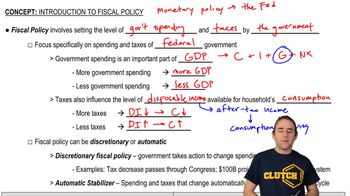
Fiscal policy refers to changes in federal government purchases, transfer payments, and taxes intended to achieve macroeconomic objectives.
Automatic stabilizers are government spending and taxes that automatically increase or decrease with the business cycle, like unemployment insurance payments rising during recessions.
Discretionary fiscal policy involves intentional government actions to change spending or taxes to influence the economy.
Expansionary fiscal policy increases government purchases or decreases taxes to raise real GDP and reduce unemployment when GDP is below potential.
Contractionary fiscal policy decreases government purchases or increases taxes to lower inflation when real GDP is above potential.
The multiplier effect is the process where an initial change in autonomous expenditure leads to a larger total change in real GDP due to induced consumption increases.
An increase in government purchases directly raises aggregate demand, which then induces further consumption, multiplying the total effect on real GDP.
Because a tax cut is partially saved and partially spent, its effect on aggregate demand and real GDP is smaller than an equivalent increase in government purchases.
Crowding out occurs when increased government spending raises interest rates, reducing private consumption, investment, and net exports.
Fiscal policy faces legislative delays and implementation delays, making it harder to act quickly compared to monetary policy.
A budget deficit occurs when government expenditures exceed tax revenues in a given period.
The federal government debt is the total value of Treasury securities outstanding, accumulated from past budget deficits.
During recessions, tax revenues fall and transfer payments rise automatically, increasing the deficit and cushioning the economic downturn.
Long-run fiscal policy aims to increase potential GDP by affecting aggregate supply through tax changes that incentivize work, saving, investment, and entrepreneurship.
A tax wedge is the difference between the pretax and posttax return to an economic activity, which can distort incentives and reduce economic activity.
Higher marginal tax rates increase the behavioral response, affecting labor supply, investment incentives, and the supply of loanable funds.
The balanced budget multiplier shows that increasing government spending and taxes by the same amount increases GDP by that amount in the short run.
Higher marginal propensity to import reduces the multiplier because some spending leaks abroad and does not increase domestic income.
The Congressional Budget Office estimated the stimulus raised real GDP by up to 4.1% and lowered unemployment by up to 1.8 percentage points in 2010.
Estimating multipliers is difficult due to simultaneous effects on aggregate demand and supply, timing issues, and differing methodologies among economists.