 Back
BackMacroeconomics: Fiscal Policy and Multipliers
 09:33
09:33
Terms in this set (20)
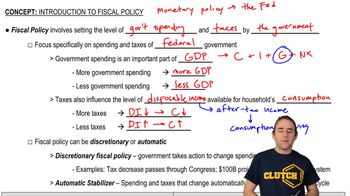
Fiscal policy refers to changes in federal government purchases, transfer payments, and taxes intended to achieve macroeconomic objectives.
Automatic stabilizers are government spending and taxes that automatically increase or decrease with the business cycle, such as unemployment insurance payments rising during recessions.
Discretionary fiscal policy involves intentional government actions to change spending or taxes to influence the economy.
An increase in government purchases directly increases aggregate demand, shifting the aggregate demand curve to the right.
Changes in taxes affect income, which in turn affects consumption, causing an indirect effect on aggregate demand.
Expansionary fiscal policy involves increasing government purchases or decreasing taxes to raise real GDP and reduce unemployment.
Contractionary fiscal policy involves decreasing government purchases or increasing taxes to reduce inflation when real GDP is above potential.
The multiplier effect is the process where an initial change in autonomous expenditure leads to a larger change in real GDP through induced consumption.
The government purchases multiplier is \(\frac{1}{1-MPC}\), where MPC is the marginal propensity to consume.
The tax multiplier is \(-\frac{MPC}{1-MPC}\) and is negative because an increase in taxes decreases equilibrium real GDP.
The balanced budget multiplier states that an equal increase in government spending and taxes increases GDP by the same amount as the increase in spending.
Higher tax rates reduce disposable income and thus reduce the government purchases multiplier.
Imports reduce the multiplier because some spending leaks abroad; the multiplier becomes \(\frac{1}{1 - MPC(1 - t) + MPI}\), where MPI is the marginal propensity to import.
Transfer payments are government payments without goods or services in return; increases raise disposable income and consumption, causing a positive multiplier effect.
Expansionary fiscal policy increases aggregate demand, which raises both real GDP and the price level due to the upward-sloping short-run aggregate supply curve.
Autonomous increases are initial government spending changes; induced increases are additional consumption spending triggered by increased income.
Real GDP increases by \$40 billion because the government purchases multiplier is 4 when MPC = 0.75.
Because tax changes affect aggregate demand indirectly through disposable income, the tax multiplier is smaller in absolute value than the direct effect of government purchases.
During a recession, expansionary fiscal policy increases government purchases or cuts taxes to raise real GDP and reduce unemployment.
During rising inflation, contractionary fiscal policy decreases government purchases or raises taxes to lower aggregate demand and reduce inflation.