 Back
BackMacroeconomics Key Concepts and Formulas
 04:36
04:36
Terms in this set (31)
Economics studies choices made due to scarce resources.
The highest-valued alternative given up to engage in an activity.
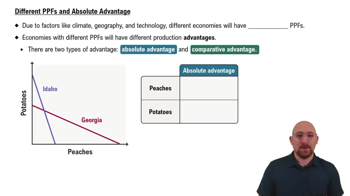
Producing more of a good or service than competitors using the same resources.
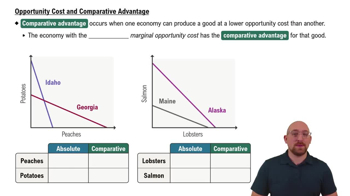
Producing at a lower opportunity cost than others; basis for trade.
Producing goods at the lowest cost.
Producing goods that consumers value most.
Total market value of all final goods and services produced in a country in a year.
\(Y=C+I+G+NX\) where C=consumption, I=investment, G=government spending, NX=net exports.
Real GDP is adjusted for inflation (base-year prices); Nominal GDP uses current-year prices.
A general, ongoing rise in price levels across the economy.
\(\frac{\text{Cost of Basket}_{current}}{\text{Cost of Basket}_{base}} \times 100\)
\(\frac{\text{New CPI} - \text{Old CPI}}{\text{Old CPI}} \times 100\)
Sum of frictional (job searching) and structural (skills mismatch) unemployment.
Unemployment caused by business cycle fluctuations, such as recessions.
Relationship between price level and quantity of real GDP demanded.
Lower price levels increase the real value of household wealth, boosting consumption.
Upward sloping; shifts right with technological advances or lower input costs.
Vertical at potential GDP, representing full employment output.
Maximum GDP an economy can produce when all factors of production are fully employed.
Maintain price stability (low inflation) and high employment.
The Fed buys T-bills to increase money supply or sells to decrease it.
Lower interest rates, increase investment, and increase aggregate demand.
Raise interest rates, decrease investment, and decrease aggregate demand.
\(M \times V = P \times Y\) where M=money supply, V=velocity, P=price level, Y=real output.
\(\frac{1}{1 - MPC}\), where MPC is marginal propensity to consume.
\(\frac{-MPC}{1 - MPC}\)
Government borrowing raises interest rates, reducing private investment.
Inverse relationship between inflation and unemployment.
Vertical at the NAIRU; no long-run trade-off between inflation and unemployment.
\(\frac{70}{\text{Growth Rate}} = \text{Years to Double}\)
\(\text{Nominal Rate} - \text{Inflation Rate}\)