 Back
BackMacroeconomics Key Concepts and Policies
 01:33
01:33
Terms in this set (30)
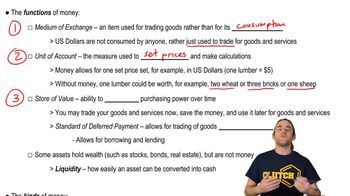
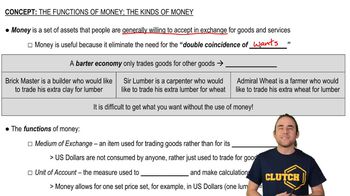
Medium of exchange, unit of account, and store of value are the three main functions of money.
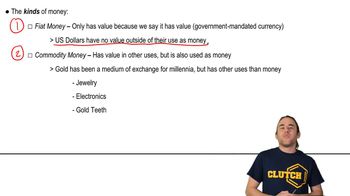
Money made valid by government law and tax-payability, without intrinsic value.
Includes circulating cash and demand deposits (checking accounts); most liquid money.
Banks hold only a fraction of deposits as reserves and create new deposits through loans.
Banks create deposits when making loans; loans are assets, deposits are liabilities for banks.
Central bank of banks; sets reserve requirements, policy interest rate, and provides reserves.
Minimum percentage of deposits banks must hold as reserves by law.
Fed buys/sells Treasury securities to influence money supply and short-term interest rates.
Fed facility providing emergency reserves to banks at a higher rate to discourage routine use.
Control money supply to stabilize prices and reduce unemployment.
Flat segment: output responds strongly to demand; vertical segment: output fixed, price changes only.
Government spending has a larger multiplier than tax cuts; distribution affects multiplier size.
When rates approach zero, monetary policy loses effectiveness; fiscal policy becomes primary tool.
Inverse relationship between unemployment and inflation in the short run.
Faster growth in lagging economies by importing existing technologies from frontier economies.
Shows trade-off between inputs and outputs; moving frontier requires new technology or better inputs.
Adding workers without more capital leads to lower marginal productivity per worker.
Output per worker or per hour worked; real GDP per hour is standard metric.
Exports minus imports of goods, services, investment income, and transfers.
Capital inflows offset current account deficit; U.S. borrows in its own reserve currency.
Fixed pegs require intervention; floating rates determined by market supply and demand.
Countries specialize in goods with lower opportunity cost, enabling gains from trade.
Exchange rate changes affect relative prices and trade flow directions.
Firms raise prices beyond cost increases due to weaker competition and input cost shocks.
Interest rate changes take time to affect borrowing, investment, and output.
Infrastructure projects and tax cuts affect economy with delay, risking pro-cyclical effects.
Protected by law to prevent political interference in monetary policy decisions.
Supply shock raised costs, shifted AS left, causing inflation and recession simultaneously.
Higher income increases imports, boosting foreign producers' income and demand for exports.
Price increases in one country raise export prices, feeding inflation back into importing countries.