 Back
BackMacroeconomics: Monetary and Fiscal Policy
 09:33
09:33
Terms in this set (23)
Monetary policy is the actions the Federal Reserve takes to manage the money supply and interest rates to pursue macroeconomic objectives like price stability and high employment.
(a) Price stability
(b) High employment (dual mandate)
(c) Stability of financial markets and institutions
(d) Economic growth
The interest rate banks charge each other for overnight loans, targeted by the Federal Open Market Committee (FOMC) but not directly controlled.
Interest paid by the Fed to banks for reserves held, used as a tool to influence the federal funds rate in an ample-reserves regime.
The fact that the federal funds rate cannot go below zero, limiting traditional monetary policy tools.
A Fed policy to increase aggregate demand by buying long-term securities like 10-year Treasury notes.
Lowering the federal funds rate reduces interest rates, increasing investment, consumption, and net exports, shifting AD right, raising real GDP and price level.
Raising the federal funds rate increases interest rates, decreasing investment, consumption, and net exports, shifting AD left, lowering real GDP and price level.
A formula linking the Fed's federal funds rate target to current inflation, equilibrium real rate, inflation gap, and output gap.
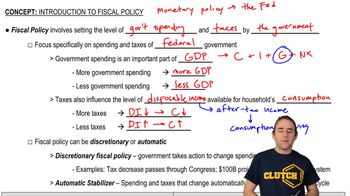
Changes in federal taxes and government purchases intended to achieve macroeconomic objectives.
Government spending and taxes that automatically increase or decrease with the business cycle without new legislation.
Increasing government purchases or decreasing taxes to shift aggregate demand right, raising real GDP and price level.
Decreasing government purchases or increasing taxes to shift aggregate demand left, lowering real GDP and price level.
The ratio of the change in equilibrium real GDP to the change in government purchases, showing how spending affects GDP.
The ratio of the change in equilibrium real GDP to the change in taxes, showing how tax changes affect GDP.
Due to timing delays in legislation and implementation, and possible crowding out of private spending.
When government expenditures exceed tax revenue in a given period.
The total value of government securities outstanding, also called the national debt.
The growth in hours worked plus the growth rate of labor productivity (real GDP per hour worked).
The difference between pretax and posttax returns to economic activity, which can distort incentives and reduce economic activity.
They influence labor supply decisions and returns to entrepreneurship.
They affect firms' incentives to invest.
They influence the supply of loanable funds from households to firms and thus the real interest rate.