Skip to main content
Macroeconomics
My Course
Learn
Exam Prep
AI Tutor
Study Guides
Flashcards
Explore
Try the app
My Course
Learn
Exam Prep
AI Tutor
Study Guides
Flashcards
Explore
Try the app
Back
Macroeconomics: Unemployment and Inflation
You can tap to flip the card.
What is the labor force?
You can tap to flip the card.
👆
What is the labor force?
The labor force is the sum of employed and unemployed workers in the economy.
Track progress
Control buttons has been changed to "navigation" mode.
1/23
Recommended videos
Guided course
04:35
Problems with Measuring Unemployment
3057
views
111
rank
Guided course
05:58
Labor Force and Unemployment
1167
views
40
rank
Terms in this set (23)
Hide definitions
What is the labor force?
The labor force is the sum of employed and unemployed workers in the economy.
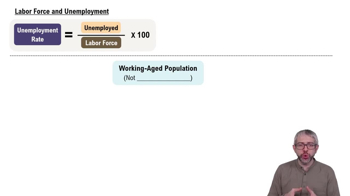
How is the unemployment rate defined?
The unemployment rate is the percentage of the labor force that is unemployed.
What is the labor force participation rate?
The labor force participation rate is the percentage of the working-age population that is in the labor force.
What does the employment-population ratio measure?
The employment-population ratio is the percentage of the working-age population that is employed.
Who are discouraged workers?
Discouraged workers are people available for work but have not looked for a job in the past four weeks because they believe no jobs are available.
What are the three types of unemployment?
The three types are frictional unemployment, structural unemployment, and cyclical unemployment.
Define frictional unemployment.
Short-term unemployment arising from the process of matching workers with jobs, including job search and seasonal unemployment.
Define structural unemployment.
Unemployment caused by a persistent mismatch between workers' skills and job requirements, often requiring retraining.
What is cyclical unemployment?
Unemployment caused by business cycle recessions, rising during downturns and falling during recoveries.
What is the natural rate of unemployment?
The normal rate of unemployment consisting of frictional and structural unemployment, typically between 4% and 5% in the U.S.
How can unemployment insurance affect unemployment?
Unemployment insurance may increase unemployment by encouraging workers to search longer for better jobs.
What effect do minimum wage laws have on unemployment?
Minimum wage increases can reduce teenage employment slightly, but overall unemployment effects are small at current levels.
What are efficiency wages?
Above-market wages paid by firms to increase worker productivity and reduce turnover, potentially causing unemployment.
What is the consumer price index (CPI)?
A measure of the average prices urban consumers pay for a fixed basket of goods and services.
How is the CPI calculated?
CPI = (Cost of basket in current year / Cost of basket in base year) × 100.
What is inflation rate based on CPI?
The percentage change in the CPI from one year to the next.
What are common biases in the CPI?
Substitution bias, quality change bias, new product bias, and outlet bias can cause CPI to overstate inflation.
What is the producer price index (PPI)?
An average of prices received by producers for goods and services at all production stages.
How do nominal and real variables differ?
Nominal variables are measured in current dollars; real variables are adjusted for inflation using price indexes.
How is the real interest rate calculated?
Real interest rate ≈ nominal interest rate minus the inflation rate.
What problems does inflation cause?
Inflation redistributes income, increases costs of holding cash, causes menu costs, and can distort taxes on nominal returns.
Why is unanticipated inflation problematic?
It makes borrowing and lending risky because it is hard to predict real returns.
How does inflation affect people with fixed incomes?
Inflation reduces the purchasing power of fixed incomes, making it harder for retirees and others to maintain living standards.
 BackBack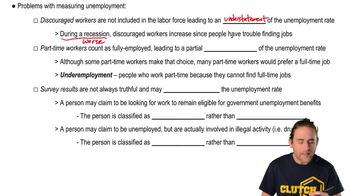
 04:35
04:35