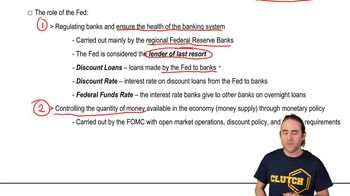
Monetary policy is the actions the Federal Reserve takes to manage the money supply and interest rates to pursue macroeconomic policy objectives.
What are the four main goals of the Federal Reserve's monetary policy?
1. Price stability 2. High employment 3. Stability of financial markets and institutions 4. Economic growth
Why is price stability a key goal of monetary policy?
Rising prices reduce the purchasing power of money, eroding its value as a medium of exchange and store of value.
What is the dual mandate of the Federal Reserve?
The dual mandate refers to the Fed's goals of achieving price stability and high employment.
How does the Fed promote stability of financial markets and institutions?
By making funds available to banks in times of crisis, ensuring confidence and liquidity in the financial system.
What is the Federal Funds Rate?
The interest rate banks charge each other for overnight loans of reserves.
How does the Fed influence the federal funds rate?
The Fed sets target ranges for the federal funds rate and uses tools like open market operations and interest on reserve balances to achieve these targets.
What is the difference between expansionary and contractionary monetary policy?
Expansionary policy lowers the federal funds rate to increase aggregate demand and real GDP; contractionary policy raises the rate to reduce inflation and slow economic growth.
What tools does the Fed use in a scarce-reserves regime to control the federal funds rate?
The Fed adjusts the supply of reserves to influence the federal funds rate.
What tools does the Fed use in an ample-reserves regime to control the federal funds rate?
The Fed adjusts the interest rate on reserve balances (IORB) to influence the federal funds rate.
What is the purpose of the interest rate on overnight reverse repurchase agreements (ON RRP)?
It sets a floor under the federal funds rate by allowing financial firms to invest funds risk-free overnight with the Fed.
Name the Fed's three traditional monetary policy tools.
Open market operations, discount rate, and reserve requirements.
How does monetary policy affect aggregate demand?
Lower interest rates increase consumption, investment, and net exports, shifting aggregate demand to the right.
Why might the Fed implement contractionary monetary policy?
To reduce inflation when the economy is producing above potential GDP, promoting long-run price stability.
Can the Fed completely eliminate recessions?
No, the Fed can only make recessions milder and shorter due to lags in data and imperfect knowledge of economic conditions.
What is quantitative easing?
A monetary policy tool used when the federal funds rate is near zero, involving the Fed buying Treasury securities to increase the money supply.
What is forward guidance in monetary policy?
A communication strategy where the Fed signals its intent to keep interest rates low for a prolonged period to influence expectations.
How does the dynamic aggregate demand and aggregate supply model differ from the static model?
It accounts for annual increases in potential GDP, aggregate demand, and short-run aggregate supply, reflecting long-run growth and inflation.
What happens when the Fed uses expansionary monetary policy in the dynamic AD-AS model?
Aggregate demand increases, real GDP returns to potential, and inflation rises more than it would have otherwise.
What is the effect of contractionary monetary policy in the dynamic AD-AS model?
Aggregate demand decreases, reducing inflation and real GDP growth compared to what would have occurred without the policy.
 Back
Back
 05:05
05:05