 Back
BackChapter 1: Introduction to Medical Terminology – Study Notes
Study Guide - Smart Notes
 Tailored notes based on your materials, expanded with key definitions, examples, and context.
Introduction to Medical Terminology
Overview of Medical Terminology
Medical terminology is a specialized language used by healthcare professionals to ensure clear, concise, and accurate communication. It is encountered in various settings, including clinical practice, media, and everyday conversations about health.
Purpose: Efficiently conveys specific and important information.
Precision: Each term has a precise meaning, allowing detailed information to be shared succinctly.
Usage: Found in doctor's offices, medical records, and healthcare discussions.

Types and Origins of Medical Terms
Three Types of Medical Terms
Medical terms are derived from various sources, each contributing to the language of medicine:
Latin and Greek word parts: e.g., cardiology, tonsillectomy
Eponyms: Terms based on a person's name, e.g., Parkinson disease, Alzheimer disease
Modern English words: e.g., irritable bowel syndrome, magnetic resonance imaging
Elements of Medical Terms
Word Roots
The word root is the foundation of most medical terms, providing the essential meaning. It often refers to a body structure, organ, or system.
Examples:
arthr – joint
carcin – cancer
cardi – heart
cephal – head
electr – electricity
gastr – stomach
hepat – liver
my – muscle
oste – bone
rhin – nose

Suffixes
A suffix is found at the end of a medical term and provides information about the word root, such as conditions, diseases, surgical procedures, or diagnostic procedures. All medical terms must have a suffix.
Examples:
-ectomy – surgical removal (e.g., gastrectomy: surgical removal of the stomach)
-itis – inflammation (e.g., arthritis: inflammation of a joint)
-megaly – enlarged (e.g., hepatomegaly: enlarged liver)
-logy – study of (e.g., cardiology: study of the heart)
-gram – record or picture (e.g., electrocardiogram: record of the heart's electricity)
-pathy – disease (e.g., myopathy: muscle disease)
Prefixes
A prefix is found at the beginning of a medical term and provides information about the word root, such as abnormal conditions, numbers, positions, or times. Many medical terms do not have a prefix.
Examples:
inter- – between (e.g., intervertebral: between the vertebrae)
a- – without (e.g., apnea: without breathing)
dys- – abnormal, difficult, or painful (e.g., dysuria: painful urination)
sub- – below, underneath (e.g., subcutaneous: below the skin)
bi- – two (e.g., bilateral: two sides)
post- – after (e.g., postsurgical: after surgery)
Combining Vowel
The combining vowel (almost always "o") is used to connect word parts and make terms easier to pronounce. It does not have any meaning itself.
Placed between a word root and a suffix (if the suffix begins with a consonant) or between two word roots.
Not placed between a prefix and a word root.
Examples:
arthr + -itis = arthritis (no combining vowel needed as suffix begins with a vowel)
rhin + -plasty = rhinoplasty (combining vowel used as suffix begins with a consonant)
gastr + enter + -logy = gastroenterology (combining vowel used between two word roots)
Combining Form
The combining form is not a separate word part but a standard way to write word roots with their combining vowel, making them easier to pronounce.
Examples: gastr/o, cardi/o, arthr/o, electr/o
Analyzing and Building Medical Terms
Analyzing Medical Terms
To understand a new medical term, divide it into its word parts and define each part. This process helps deduce the meaning of unfamiliar terms.
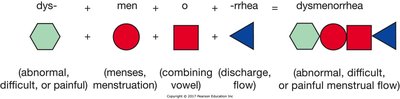
Example: dysmenorrhea
Divide: dys / men / o / rrhea
Define: dys- (abnormal, painful), men (menstruation), o (combining vowel), -rrhea (flow)
Meaning: abnormal or painful menstrual flow
Building Medical Terms
To construct a medical term, select the appropriate word roots, combining vowels, and suffixes to match the intended meaning.
Example: To build a term meaning "fibrous skin tumor":
Word roots: fibr (fibrous), dermat (skin)
Suffix: -oma (tumor)
Combine: dermat / o / fibr / oma = dermatofibroma
Forming Plurals in Medical Terms
Rules for Pluralization
Medical terms often follow specific rules for forming plurals, based on their Latin or Greek origins. The table below summarizes common patterns:
Singular Ending | Plural Ending | Example (Singular) | Example (Plural) |
|---|---|---|---|
-a | -ae | vertebra | vertebrae |
-ax | -aces | thorax | thoraces |
-ex | -ices | apex | apices |
-is | -es | metastasis | metastases |
-ix | -ices | appendix | appendices |
-ma | -mata | sarcoma | sarcomata |
-on | -a | spermatozoon | spermatozoa |
-us | -i | alveolus | alveoli |
-um | -a | ovum | ova |
-x | -ges | phalanx | phalanges |
-y | -ies | biopsy | biopsies |
Pronunciation of Medical Terms
Hints for Pronunciation
Medical terms often have unique pronunciation rules. The following guidelines help with correct pronunciation:
-ae or -oe: pronounce only the second letter (e.g., bursae = BER-see)
c and g have a soft sound if followed by e, i, or y (e.g., cerebrum = ser-REE-brum)
c and g have a hard sound if followed by other letters (e.g., cardiac = CAR-dee-ak)
ch- at the beginning of a word has a hard k sound (e.g., cholesterol = koh-LES-ter-all)
-e or -es at the end of a word is pronounced as a separate syllable (e.g., syncope = SIN-koh-pee)
-i at the end of a word is pronounced 'eye' (e.g., bronchi = BRONG-keye)
pn- at the beginning of a word: pronounce only the n (e.g., pneumonia = new-MOH-nee-ah)
pn in the middle of a word: pronounce both p and n (e.g., tachypnea = tak-ip-NEE-ah)
ps- at the beginning of a word: pronounce only the s (e.g., psychiatry = sigh-KIGH-ah-tree)
