 Back
BackIntroduction to Medical Terminology: Structure and Meaning
Study Guide - Smart Notes
 Tailored notes based on your materials, expanded with key definitions, examples, and context.
Chapter 1: Medical Language – Its Structure and Meaning
Introduction to Medical Language
Medical language is the specialized language used in healthcare settings. It consists of words and terms that describe the human body, diseases, procedures, and treatments. Understanding medical language is essential for effective communication among healthcare professionals and for accurate documentation and patient care.
Medical Language Skills
Reading medical words: Recognizing and interpreting written medical terms.
Hearing medical words: Understanding spoken medical terminology.
Thinking, analyzing, and understanding medical words: Processing and comprehending the meaning of terms.
Writing (or typing) and spelling medical words: Accurately recording medical information.
Speaking and pronouncing medical words: Communicating clearly with others in the healthcare field.

The Origins of Medical Language
Etymology is the study of word origins. Most medical terms are derived from Greek and Latin, reflecting the historical contributions of these cultures to medicine. Some terms are identical to their original forms, while others have been adapted. A smaller number of terms come from other languages.
Medical Nouns and Word Parts
Singular and Plural Nouns
English nouns: Most form plurals by adding -s (e.g., gland → glands). Nouns ending in -y change to -ies (e.g., artery → arteries).
Greek and Latin nouns: Have specific rules for forming plurals, which must be memorized for accurate usage in medical contexts.
Word Parts
Medical words are constructed from three main types of word parts:
Prefix: An optional word beginning that modifies the meaning of the word.
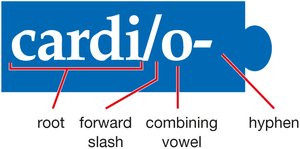
Combining form: The foundation of a medical word, consisting of a root, a forward slash, a combining vowel (usually 'o'), and a hyphen.
Suffix: The ending of a medical word that modifies or clarifies the meaning.
Combining Forms
Some combining forms are nearly identical to their medical meaning (e.g., cardi/o- means heart).
Others are related or not directly related to their meaning, often due to differences between Greek and Latin roots.
Multiple combining forms may exist for the same structure due to these linguistic origins.
Suffixes
Suffixes are word parts at the end of medical terms. They can indicate adjectives, processes, diseases, procedures, or medical specialties/specialists.

Adjective suffixes: Indicate a descriptive quality (e.g., -ac means 'pertaining to').
Process suffixes: Indicate an action or process (e.g., -logy means 'study of').
Disease suffixes: Indicate a disease or condition (e.g., -itis means 'inflammation').
Procedure suffixes: Indicate a medical procedure (e.g., -gram means 'record' or 'picture').
Specialty/specialist suffixes: Indicate a field or practitioner (e.g., -ist means 'specialist').


Prefixes
Prefixes, if present, appear at the beginning of a medical word and modify its meaning. They can indicate location, direction, amount, number, speed, degree, or quality.

Analyzing and Building Medical Words
Defining Medical Words
To define a medical word, follow these steps:
Divide the word into its combining form, suffix, and prefix (if present).
Determine the meaning of each word part.
Put the meanings in order: suffix, prefix (if present), then combining form.
Add connecting words to make a clear definition.




Building Medical Words
Building medical words is the reverse process of defining them. The steps depend on whether the suffix begins with a consonant or vowel and whether a prefix is present.
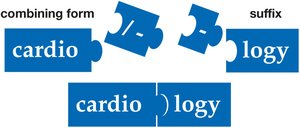
If the suffix begins with a consonant, retain the combining vowel (e.g., cardi/o/logy).
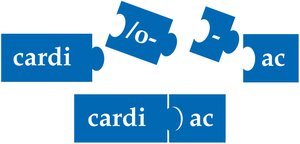
If the suffix begins with a vowel, drop the combining vowel (e.g., cardi/ac).
If a prefix is present, it is placed at the beginning, followed by the combining form and suffix.







Spelling and Pronunciation of Medical Words
Correct spelling is essential for clear communication and accurate documentation in healthcare.
Pronunciation is important for verbal communication among healthcare professionals.
Understanding the meaning of word parts aids in both spelling and pronunciation.
Summary Table: Types of Word Parts in Medical Terminology
Word Part | Position | Function | Example |
|---|---|---|---|
Prefix | Beginning (optional) | Modifies meaning (location, number, etc.) | intra- (within) |
Combining Form | Foundation | Indicates main meaning (body part, system, etc.) | cardi/o- (heart) |
Suffix | End | Clarifies meaning (condition, procedure, specialty, etc.) | -logy (study of), -ac (pertaining to) |
Additional info: Mastery of medical terminology is foundational for all healthcare professionals, as it ensures precise communication and reduces the risk of errors in patient care.
