 Back
Medical Terminology: Musculoskeletal System – Skeletal System Word Parts and Adjective Forms
Study Guide - Smart Notes
 Tailored notes based on your materials, expanded with key definitions, examples, and context.
Musculoskeletal System: Skeletal System at a Glance
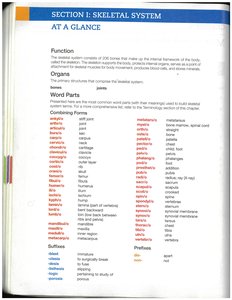
Function of the Skeletal System
The skeletal system consists of 206 bones that make up the internal framework of the body. It provides structure, protects vital organs, enables movement, and serves as a site for blood cell production and mineral storage. Muscles attach to bones to facilitate movement, and joints allow for flexibility and articulation.
Support: Provides structural support for the body.
Protection: Shields internal organs (e.g., skull protects the brain).
Movement: Works with muscles to produce movement.
Blood Cell Production: Bone marrow produces blood cells.
Mineral Storage: Stores calcium and phosphorus.
Organs of the Skeletal System
Bones: The primary structural components.
Joints: Sites where two or more bones meet, allowing movement.
Word Parts Used in Skeletal System Terminology
Combining Forms, Suffixes, and Prefixes
Medical terms for the skeletal system are constructed using combining forms, suffixes, and prefixes. Understanding these word parts is essential for interpreting and constructing anatomical and pathological terms.
Combining Forms: Root words that refer to specific bones, tissues, or anatomical features (e.g., oste/o for bone, arthr/o for joint).
Suffixes: Indicate procedures, conditions, or specialties (e.g., -itis for inflammation, -ectomy for removal).
Prefixes: Modify the meaning of the term (e.g., sub- for under, inter- for between).
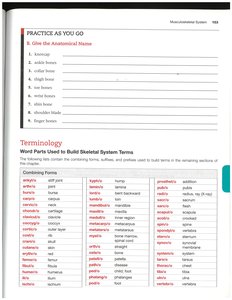
Common Combining Forms for Skeletal System
oste/o: bone
arthr/o: joint
chondr/o: cartilage
myel/o: bone marrow
cost/o: rib
crani/o: skull
vertebr/o: vertebra
femor/o: femur
tibi/o: tibia
patell/o: patella
phalang/o: phalanges (finger/toe bones)
Common Suffixes in Skeletal System Terminology
-itis: inflammation (e.g., arthritis)
-ectomy: surgical removal (e.g., meniscectomy)
-algia: pain (e.g., arthralgia)
-plasty: surgical repair (e.g., arthroplasty)
-osis: abnormal condition (e.g., scoliosis)
-logy: study of (e.g., osteology)
Common Prefixes in Skeletal System Terminology
sub-: under, below
inter-: between
peri-: around
intra-: within
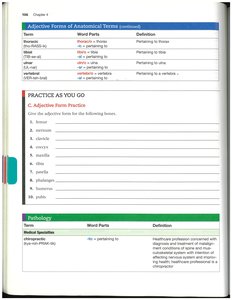
Adjective Forms of Anatomical Terms
Formation and Meaning
Adjective forms are used to describe anatomical structures in relation to specific bones or regions. These forms are constructed by combining the root word for the bone with a suffix indicating 'pertaining to.'
Example: femoral = femur + -al (pertaining to the femur)
Example: costal = costa (rib) + -al (pertaining to the rib)
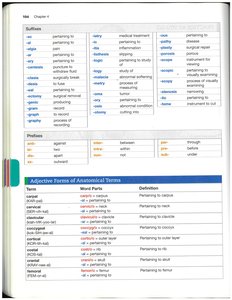
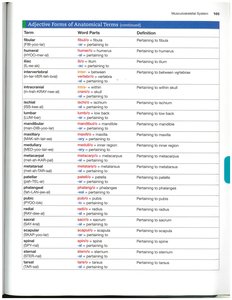
Table: Adjective Forms of Anatomical Terms
The following table summarizes common adjective forms used in skeletal system terminology:
Term | Word Parts | Definition |
|---|---|---|
femoral | femor/o + -al | Pertaining to femur |
costal | cost/o + -al | Pertaining to rib |
patellar | patell/o + -ar | Pertaining to patella |
vertebral | vertebr/o + -al | Pertaining to vertebra |
pharyngeal | pharyng/o + -eal | Pertaining to pharynx |
tibial | tibi/o + -al | Pertaining to tibia |
humeral | humer/o + -al | Pertaining to humerus |
radial | radi/o + -al | Pertaining to radius |
ulnar | uln/o + -ar | Pertaining to ulna |
scapular | scapul/o + -ar | Pertaining to scapula |
pelvic | pelv/i + -ic | Pertaining to pelvis |
fibular | fibul/o + -ar | Pertaining to fibula |
mandibular | mandibul/o + -ar | Pertaining to mandible |
maxillary | maxill/o + -ary | Pertaining to maxilla |
sternal | stern/o + -al | Pertaining to sternum |
clavicular | clavicul/o + -ar | Pertaining to clavicle |
ischial | ischi/o + -al | Pertaining to ischium |
pubic | pub/o + -ic | Pertaining to pubis |
Pathology: Medical Specialties
Medical Specialties Related to the Skeletal System
Orthopedics: The branch of medicine concerned with the diagnosis, treatment, and prevention of disorders of the bones, joints, ligaments, tendons, and muscles.
Rheumatology: Focuses on diseases of joints, muscles, and bones, especially those involving inflammation.
Term | Word Parts | Definition |
|---|---|---|
orthopedics | orth/o + ped/o + -ics | Healthcare profession specializing in the study and treatment of the musculoskeletal system. |
Practice Exercises
Practice: Anatomical Names and Adjective Forms
Students are encouraged to practice constructing anatomical and adjective forms using the provided word parts. For example, given the bone "femur," the adjective form is "femoral." Practice exercises reinforce understanding of terminology construction.
Example: Bone: tibia → Adjective form: tibial
Example: Bone: scapula → Adjective form: scapular
Additional info: The notes above expand on the brief lists and tables in the original materials, providing definitions, examples, and context for medical terminology students studying the musculoskeletal system.
