Back

4) Avoiding Complement System quiz

Control buttons has been changed to "navigation" mode.
1/15
  • What is the complement system's role in innate immunity?

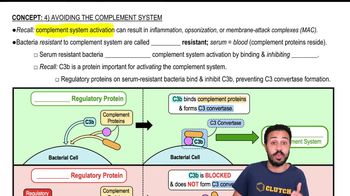
    The complement system helps destroy and eliminate pathogens through inflammation, opsonization, and formation of membrane attack complexes (MACs).
  • What are serum resistant bacteria?

    Serum resistant bacteria are pathogens that can prevent activation of the complement system, allowing them to evade destruction by innate immunity.
  • Which complement protein is crucial for activating the rest of the complement system?

    C3b is the complement protein essential for activating the rest of the complement system.
  • How do serum resistant bacteria inhibit the complement system?

    They possess regulatory proteins on their surface that bind and inhibit C3b, preventing complement system activation.
  • What happens when C3b is inhibited by regulatory proteins?

    C3b cannot form C3 convertase, so the complement system is not activated.
  • What is the result of complement system activation in normal bacterial cells?

    Activation leads to inflammation, opsonization, or formation of MACs, resulting in bacterial elimination.
  • What is the function of C3 convertase in the complement system?

    C3 convertase is necessary for activating the complement system and triggering immune responses.
  • Where are complement proteins found in the body?

    Complement proteins reside in the serum, which is a component of blood.
  • What immune responses are prevented when serum resistant bacteria inhibit complement activation?

    Inflammation, opsonization, and formation of membrane attack complexes are prevented.
  • What distinguishes serum resistant bacteria from normal bacteria regarding complement system avoidance?

    Serum resistant bacteria have surface regulatory proteins that inhibit C3b, while normal bacteria do not.
  • Why is preventing C3 convertase formation important for serum resistant bacteria?

    It stops the activation of the complement system, allowing the bacteria to evade immune destruction.
  • What is opsonization in the context of the complement system?

    Opsonization is the process where pathogens are marked for phagocytosis by immune cells.
  • What is a membrane attack complex (MAC)?

    A MAC is a structure formed by complement proteins that creates pores in pathogen membranes, leading to their destruction.
  • How does the presence of regulatory proteins affect C3b's interaction with other complement proteins?

    Regulatory proteins block C3b, preventing it from interacting with other complement proteins and forming C3 convertase.
  • What is the overall benefit for pathogens that avoid complement system activation?

    They can survive and persist in the host by evading immune responses that would otherwise destroy them.