Back

Affinity Maturation quiz

Control buttons has been changed to "navigation" mode.
1/15
  • What is affinity maturation?

    Affinity maturation is a process of natural selection among B cells that leads to the production of more effective antibodies over time.
  • Where do mutations occur during affinity maturation?

    Mutations occur in the variable region of the B cell receptor (BCR) or antibody genes, which control the antigen binding site.
  • How does affinity maturation improve antibody effectiveness?

    It selects for B cells with mutations that allow for more effective antigen binding, leading to their proliferation and the production of better antibodies.
  • What happens to B cells with mutations that decrease antigen binding?

    B cells with less effective antigen binding are less likely to proliferate and are eventually eliminated.
  • How does affinity maturation relate to antibody class switching?

    Affinity maturation works alongside antibody class switching to ensure the production of more effective antibodies during an infection.
  • What is the result of affinity maturation and class switching?

    The result is an enhanced ability of the body to defend itself against specific antigens over time.
  • Why are B cells with improved antigen binding more likely to proliferate?

    Because they are more effective at recognizing and binding antigens, which promotes their survival and division.
  • What does the variable region of the BCR control?

    The variable region controls the antigen binding site of the BCR or antibody.
  • What is the fate of B cells that accumulate beneficial mutations?

    They are more likely to proliferate and create clones with improved antigen binding capabilities.
  • How does the immune system 'select' for better antibodies during an infection?

    Through natural selection, B cells with higher affinity for the antigen are favored to proliferate.
  • What is the significance of repeated B cell division during affinity maturation?

    Repeated division increases the chance of mutations, some of which may improve antigen binding.
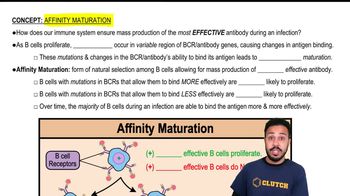
  • What do green pluses represent in the affinity maturation diagram?

    Green pluses represent B cells with more effective antigen binding.
  • What do red pluses represent in the affinity maturation diagram?

    Red pluses represent B cells with less effective antigen binding.
  • How does affinity maturation affect the immune response over time?

    It allows the immune system to produce antibodies that bind more effectively to antigens as an infection progresses.
  • Why do B cells stop dividing if they have less effective antigen binding?

    Because they are less likely to be selected for proliferation, leading to their elimination from the population.