Back

Clonal Selection definitions

Control buttons has been changed to "navigation" mode.
1/14
  • Clonal Selection

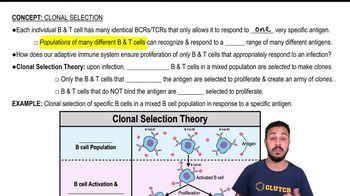
    Process where only lymphocytes recognizing a specific antigen are chosen to multiply and mount an immune response.
  • B Cell

    Lymphocyte type with unique surface receptors, capable of differentiating into antibody-secreting or memory cells.
  • T Cell

    Lymphocyte type with unique surface receptors, essential for adaptive immunity and recognizing specific antigens.
  • Antigen

    Foreign molecule that triggers a specific immune response by binding to lymphocyte receptors.
  • BCR

    Surface molecule on B cells responsible for recognizing and binding to a unique antigen.
  • TCR

    Surface molecule on T cells responsible for recognizing and binding to a unique antigen.
  • Proliferation

    Rapid multiplication of selected lymphocytes after antigen recognition, producing identical clones.
  • Clone

    Genetically identical group of lymphocytes derived from a single activated cell.
  • Differentiation

    Process where activated lymphocytes change into specialized cells, such as plasma or memory cells.
  • Plasma Cell

    Specialized B cell that produces and secretes large amounts of antibodies specific to an antigen.
  • Memory B Cell

    Long-lived B cell capable of mounting a rapid response upon re-exposure to the same antigen.
  • Adaptive Immune System

    Body defense system characterized by specificity and memory, involving B and T cells.
  • Mixed Population

    Diverse group of lymphocytes, each with unique receptors, present before antigen exposure.
  • Antibody

    Protein produced by plasma cells that binds specifically to an antigen, aiding in its elimination.