Back

Clonal Selection quiz

Control buttons has been changed to "navigation" mode.
1/15
  • What does the clonal selection theory explain in the immune system?

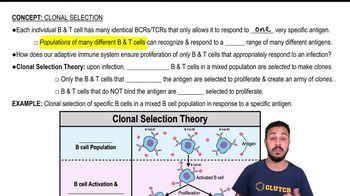
    It explains how specific B and T cells are activated and proliferate in response to a particular antigen.
  • What is unique about the BCRs or TCRs on each B or T cell?

    Each B or T cell has many identical BCRs or TCRs that respond to only one specific antigen.
  • How does the body ensure a diverse immune response to many antigens?

    The body has pre-existing populations of B and T cells with different BCRs and TCRs, allowing recognition of a wide range of antigens.
  • What happens to B and T cells that do not bind the specific antigen during an infection?

    They are not selected to proliferate and will not respond unless their specific antigen is present.
  • What is the first step in clonal selection after an antigen enters the body?

    Only the B and T cells that recognize and bind the antigen are selected for activation.
  • What does proliferation mean in the context of clonal selection?

    Proliferation means the activated B or T cell multiplies to create identical clones.
  • What is the outcome of B cell activation and proliferation?

    An army of identical B cell clones is produced, all capable of responding to the specific antigen.
  • What are the two types of cells that activated B cells can differentiate into?

    Activated B cells can differentiate into plasma cells or memory B cells.
  • What is the function of plasma cells in the immune response?

    Plasma cells secrete antibodies specific to the antigen, helping to eliminate it.
  • What is the role of memory B cells after clonal selection?

    Memory B cells enable a faster response to future infections by the same antigen.
  • Does clonal selection apply only to B cells?

    No, clonal selection applies to both B cells and T cells.
  • What determines which B cell in a mixed population will be activated?

    The B cell with BCRs that can bind the specific antigen will be activated.
  • What happens to B cells that do not recognize the present antigen?

    They remain inactive and do not proliferate unless their specific antigen appears.
  • How do antibodies produced by plasma cells relate to the antigen?

    The antibodies are specific to the antigen that triggered the clonal selection.
  • Why is clonal selection important for the adaptive immune system?

    It ensures that only cells capable of responding to the infection proliferate, making the immune response efficient and specific.