Back

Epidemiological Studies quiz

Control buttons has been changed to "navigation" mode.
1/15
  • What are the three main types of epidemiological studies?

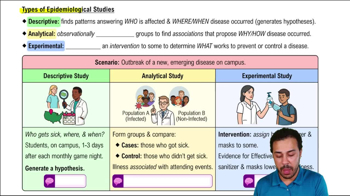
    The three main types are descriptive, analytical, and experimental studies.
  • What is the primary purpose of a descriptive epidemiological study?

    Descriptive studies identify patterns of disease occurrence and answer questions about who, where, and when the disease occurs.
  • What kind of questions do descriptive studies help answer?

    They help answer who is affected, where cases occur, and when cases occur.
  • What is the main goal of analytical epidemiology?

    Analytical epidemiology tests hypotheses by comparing exposed and unexposed groups to find statistical associations.
  • How do analytical studies differ from descriptive studies?

    Analytical studies test hypotheses by comparing groups, while descriptive studies only generate hypotheses by describing patterns.
  • What is the role of experimental epidemiology?

    Experimental epidemiology involves assigning interventions to groups to evaluate their effectiveness in preventing or controlling disease.
  • In the campus outbreak scenario, what hypothesis might a descriptive study generate?

    A descriptive study might hypothesize that attending monthly game nights is associated with increased disease occurrence.
  • How are groups formed in an analytical epidemiological study?

    Groups are formed based on exposure to potential risk or protective factors, such as cases (sick) and controls (not sick).
  • What is the key feature of experimental studies that distinguishes them from analytical studies?

    Experimental studies assign interventions to some individuals, while analytical studies do not manipulate subjects.
  • What is an example of an intervention in an experimental epidemiological study?

    An example is providing hand sanitizer and masks to some individuals and comparing their outcomes to those who did not receive them.
  • Why are descriptive studies important in the early stages of investigating a new disease?

    They help generate hypotheses about risk and protective factors by identifying patterns in disease occurrence.
  • What does an analytical study look for when comparing groups?

    It looks for significant statistical associations between exposure to factors and disease occurrence.
  • What outcome would suggest that an intervention is effective in an experimental study?

    If the group receiving the intervention has a lower risk of illness compared to the control group, the intervention is considered effective.
  • How do experimental studies contribute to public health responses?

    They provide evidence on what interventions work to prevent or control diseases, guiding public health strategies.
  • What is the main difference in the approach between descriptive, analytical, and experimental studies?

    Descriptive studies describe patterns, analytical studies compare groups without intervention, and experimental studies assign and test interventions.