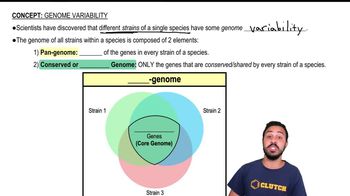
The pangenome refers to all the genes found in every strain of a species, including both unique and conserved genes.
What does the core genome represent?
The core genome consists of genes that are conserved and shared across all strains of a species.
How do mobile genetic elements contribute to genome variability?
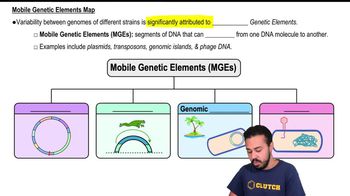
Mobile genetic elements can move DNA segments within or between genomes, increasing genetic diversity among strains.
Name four types of mobile genetic elements.
The four types are plasmids, transposons, genomic islands, and phage DNA.
What is a plasmid?
A plasmid is a circular, double-stranded DNA molecule with its own origin of replication, capable of independent replication within a cell.
What is the difference between high copy number and low copy number plasmids?
High copy number plasmids replicate quickly and are found in large numbers, while low copy number plasmids replicate slowly and are found in fewer copies.
What are resistance plasmids (R plasmids)?
Resistance plasmids carry genes that confer antibiotic resistance, allowing cells to survive in the presence of antibiotics.
How are resistance plasmids typically transferred between cells?
Most resistance plasmids are conjugative and can be transferred horizontally between cells via conjugation.
What is a transposon?
A transposon, or jumping gene, is a DNA segment that can change its position within a genome through transposition.
What enzyme do transposons encode, and what is its function?
Transposons encode the enzyme transposase, which catalyzes the movement (transposition) of the transposon within the genome.
What is insertional inactivation?
Insertional inactivation occurs when a transposon inserts into a gene, disrupting and inactivating that gene.
What are genomic islands and how are they acquired?
Genomic islands are large DNA regions in a bacterial chromosome, often acquired from other species via horizontal gene transfer.
How can scientists identify genomic islands?
Genomic islands can be identified by their unique GC base pair ratio, which differs from the rest of the chromosome.
What are pathogenicity islands?
Pathogenicity islands are genomic islands containing genes that enable a cell to cause disease.
How does phage DNA act as a mobile genetic element?
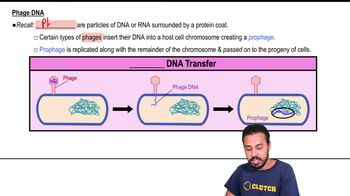
Phage DNA can integrate into a bacterial chromosome as a prophage, be replicated with the host genome, and transferred to progeny, contributing to genome variability.
 Back
Back
 01:44
01:44