Back

Germination quiz

Control buttons has been changed to "navigation" mode.
1/15
  • What is germination in the context of endospores?

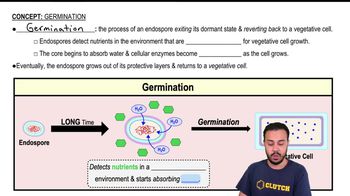
    Germination is the process by which an endospore exits its dormant state and reverts back to a vegetative cell.
  • How is germination related to sporulation?

    Germination is the opposite of sporulation; germination starts with an endospore and ends with a vegetative cell, while sporulation starts with a vegetative cell and ends with an endospore.
  • What triggers the germination of an endospore?

    The detection of favorable nutrients in the environment triggers the germination of an endospore.
  • What happens to the core of the endospore during germination?

    The core of the endospore absorbs water during germination.
  • Why is water absorption important in germination?

    Water absorption activates cellular enzymes necessary for the germination process.
  • What role do activated enzymes play in germination?

    Activated enzymes facilitate the transformation of the endospore back into a vegetative cell.
  • What can a vegetative cell do after germination is complete?

    After germination, the vegetative cell can perform normal functions and reproduce in favorable conditions.
  • What can happen to a vegetative cell if it encounters unfavorable conditions again?

    If faced with unfavorable environments, the vegetative cell can revert to the endospore form through sporulation.
  • What is the initial state and final state in the process of germination?

    The initial state is an endospore, and the final state is a vegetative cell.
  • How long can an endospore remain dormant before germination?

    An endospore can last in its dormant state for a long period of time before germination.
  • What environmental cue is often represented in diagrams as triggering germination?

    The presence of nutrients, such as glucose molecules, is often shown as the trigger for germination.
  • What is the main purpose of the endospore’s protective layers?

    The protective layers allow the endospore to survive in a dormant state until conditions become favorable.
  • What is the sequence of events during germination after nutrient detection?

    After nutrient detection, the endospore absorbs water, activates enzymes, and then reverts to a vegetative cell.
  • Can a cell undergo germination more than once?

    Yes, a cell can revert to an endospore through sporulation and then undergo germination again if conditions become favorable.
  • Why is germination important for bacterial survival?

    Germination allows bacteria to resume growth and reproduction when environmental conditions improve, ensuring their survival.