Back

Major Histocompatibility Complex Molecules quiz

Control buttons has been changed to "navigation" mode.
1/15
  • What is the main function of Major Histocompatibility Complexes (MHCs) on host cells?

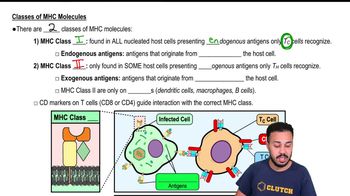
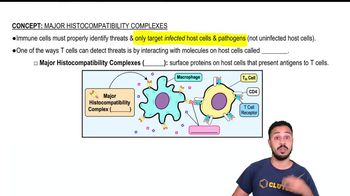
    MHCs present antigens to T cells, enabling the immune system to generate an appropriate response.
  • Which type of T cell recognizes antigens presented by MHC Class I molecules?

    Cytotoxic T cells (CD8 cells) recognize antigens presented by MHC Class I molecules.
  • Where are MHC Class I molecules found in the body?

    MHC Class I molecules are found on all nucleated host cells.
  • What type of antigens do MHC Class I molecules present?

    MHC Class I molecules present endogenous antigens, which originate from inside the cell.
  • Which cells recognize antigens presented by MHC Class II molecules?

    Helper T cells (CD4 cells) recognize antigens presented by MHC Class II molecules.
  • On which cells are MHC Class II molecules found?

    MHC Class II molecules are found only on antigen presenting cells (APCs) such as dendritic cells, macrophages, and B cells.
  • What type of antigens do MHC Class II molecules present?

    MHC Class II molecules present exogenous antigens, which originate from outside the cell.
  • What is the role of CD markers on T cells in MHC interactions?

    CD markers guide T cells to interact with the correct MHC class: CD8 with MHC I and CD4 with MHC II.
  • What happens when a T cell recognizes an antigen on an MHC molecule?

    Recognition triggers the T cell to generate an appropriate immune response.
  • Can antigen presenting cells (APCs) have both MHC Class I and Class II molecules?

    Yes, APCs are nucleated and thus have both MHC Class I and Class II molecules.
  • What is an example of an endogenous antigen presented by MHC Class I?

    A viral antigen from a virus replicating inside a host cell is an example of an endogenous antigen.
  • How are exogenous antigens processed for presentation by MHC Class II molecules?

    Exogenous antigens are internalized by APCs and then presented on the cell surface by MHC Class II molecules.
  • Which T cell type does NOT recognize antigens on MHC Class II molecules?

    Cytotoxic T cells (CD8 cells) do not recognize antigens on MHC Class II molecules.
  • Which T cell type does NOT recognize antigens on MHC Class I molecules?

    Helper T cells (CD4 cells) do not recognize antigens on MHC Class I molecules.
  • Why is it important for immune cells to distinguish between infected and healthy host cells?

    This distinction ensures that immune responses target only threats and avoid harming healthy, uninfected cells.