Skip to main content
Microbiology
My Course
Learn
Exam Prep
AI Tutor
Study Guides
Textbook Solutions
Flashcards
Explore
Try the app
My Course
Learn
Exam Prep
AI Tutor
Study Guides
Textbook Solutions
Flashcards
Explore
Try the app
Back
Proteins quiz
You can tap to flip the card.
What type of bond links adjacent amino acids together in a protein chain?
You can tap to flip the card.
👆
What type of bond links adjacent amino acids together in a protein chain?
Peptide bonds covalently link adjacent amino acids together in a protein chain.
Track progress
Control buttons has been changed to "navigation" mode.
1/15
Related flashcards
Related practice
Recommended videos
Proteins definitions
Proteins
14 Terms
Proteins
5. Molecules of Microbiology
4 problems
Topic
Nicole
Nucleic Acids
5. Molecules of Microbiology
7 problems
Topic
Nicole
5. Molecules of Microbiology
8 topics
14 problems
Chapter
Nicole
08:02
Protein Structure
24970
views
334
rank
04:37
Amino Acids
25660
views
450
rank
02:50
Proteins
31218
views
594
rank
Terms in this set (15)
Hide definitions
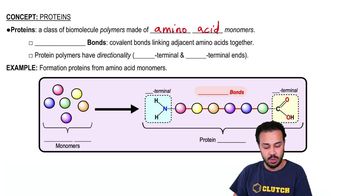
What type of bond links adjacent amino acids together in a protein chain?
Peptide bonds covalently link adjacent amino acids together in a protein chain.
What are the two chemically distinct ends of a protein polymer called?
The two ends are called the N-terminal (amino group) and the C-terminal (carboxyl group).
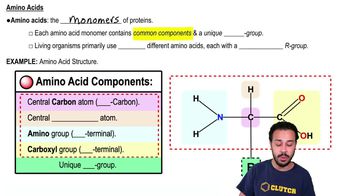
What are the common components found in every amino acid?
Every amino acid has a central alpha carbon, an amino group, a carboxyl group, and a hydrogen atom.
What makes one amino acid different from another?
The unique R group, which varies in size and properties, distinguishes each amino acid.
How many different amino acids are primarily used by living organisms?
Living organisms primarily use 20 different amino acids.
What is an oligopeptide?
An oligopeptide is a chain of 2 to 20 covalently linked amino acids.
What is the difference between a peptide and a polypeptide?
A peptide has fewer than 50 amino acids, while a polypeptide has more than 50 amino acids.
What defines a protein in terms of structure?
A protein is one or more polypeptide chains in their folded, functional forms.
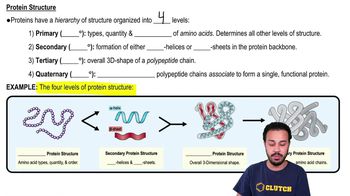
What is the primary level of protein structure?
The primary structure is the specific sequence, types, and quantity of amino acids in the chain.
What structures are formed at the secondary level of protein structure?
The secondary structure involves the formation of alpha helices or beta sheets in the protein backbone.
What does the tertiary level of protein structure refer to?
Tertiary structure refers to the overall three-dimensional shape of the polypeptide chain.
What is quaternary protein structure?
Quaternary structure is when multiple polypeptide chains associate to form a single functional protein.
What is a denatured protein?
A denatured protein is a nonfunctional protein that has lost its shape due to environmental changes.
What environmental factors can cause protein denaturation?
Changes in pH, temperature, or salt concentration can cause protein denaturation.
What role do chaperone proteins play in cells?
Chaperone proteins help other proteins regain their original shape and become functional again.
 BackBack
 08:02
08:02