Microbiology
My Course
Learn
Exam Prep
AI Tutor
Study Guides
Textbook Solutions
Flashcards
Explore
My Course
Learn
Exam Prep
AI Tutor
Study Guides
Textbook Solutions
Flashcards
Explore
Back
Simple and Facilitated Diffusion quiz
You can tap to flip the card.
Define:
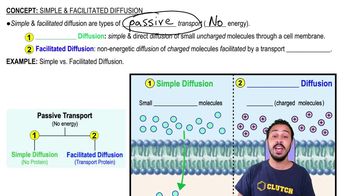
What is passive transport and does it require energy input?
You can tap to flip the card.
👆
What is passive transport and does it require energy input?
Passive transport is the movement of molecules across the membrane without energy input; it does not require any energy.
Track progress
Control buttons has been changed to "navigation" mode.
1/15
Related flashcards
Related practice
Recommended videos
Simple and Facilitated Diffusion definitions
Simple and Facilitated Diffusion
14 Terms
Active Transport
6. Cell Membrane & Transport
4 problems
Topic
Monica
6. Cell Membrane & Transport - Part 1 of 2
7 topics
12 problems
Chapter
Monica
6. Cell Membrane & Transport - Part 2 of 2
7 topics
11 problems
Chapter
Brendan
Guided course
05:10
Simple and Facilitated Diffusion
Jason
17462
views
244
rank
Guided course
04:49
Transport Proteins of Facilitated Diffusion
Jason
14593
views
187
rank
Terms in this set (15)
Hide definitions
What is passive transport and does it require energy input?
Passive transport is the movement of molecules across the membrane without energy input; it does not require any energy.
In which direction do molecules move during simple and facilitated diffusion?
Molecules move down their concentration gradients, from areas of high concentration to areas of low concentration.
What type of molecules can pass through the membrane via simple diffusion?
Small, uncharged molecules can pass directly through the cell membrane via simple diffusion.
Does simple diffusion require the assistance of transport proteins?
No, simple diffusion does not require any transport proteins.
What type of molecules typically require facilitated diffusion to cross the membrane?
Charged molecules or ions typically require facilitated diffusion to cross the membrane.
What is the main difference between simple diffusion and facilitated diffusion?
Simple diffusion does not require transport proteins, while facilitated diffusion requires transport proteins to assist molecule movement.
Name the two main types of transport proteins involved in facilitated diffusion.
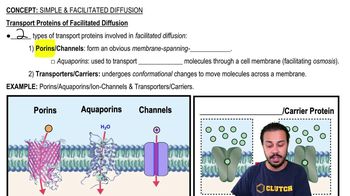
The two main types are porins (channels) and transporters (carriers).
How do porins (channels) facilitate diffusion across the membrane?
Porins form membrane-spanning tunnels that allow molecules to pass through the membrane.
What is the specific function of aquaporins?
Aquaporins are porins that specifically facilitate the rapid movement of water molecules across the membrane, enhancing osmosis.
How do transporter (carrier) proteins move molecules across the membrane?
Transporters undergo conformational changes and are only open to one side of the membrane at a time, moving molecules across by changing shape.
Do facilitated diffusion processes require energy input?
No, facilitated diffusion is a passive process and does not require energy input.
What is the role of ion channels in facilitated diffusion?
Ion channels are a type of porin that allow charged ions to move through the membrane down their concentration gradients.
Why can't ions cross the membrane via simple diffusion?
Ions are charged and cannot pass through the hydrophobic core of the membrane without the help of transport proteins.
What does it mean for a transporter to undergo a conformational change?
It means the transporter changes its shape to move a molecule from one side of the membrane to the other.
How are porins and transporters similar in their function?
Both porins and transporters facilitate the passive movement of molecules down their concentration gradients without energy input.