Skip to main content
Microbiology
My Course
Learn
Exam Prep
AI Tutor
Study Guides
Textbook Solutions
Flashcards
Explore
Try the app
My Course
Learn
Exam Prep
AI Tutor
Study Guides
Textbook Solutions
Flashcards
Explore
Try the app
Back
Simple Staining definitions
You can tap to flip the card.
Simple Staining
You can tap to flip the card.
👆
Simple Staining
A technique using a single dye to enhance contrast, making cells easier to visualize under bright field microscopy.
Track progress
Control buttons has been changed to "navigation" mode.
1/14
Related flashcards
Related practice
Recommended videos
Simple Staining quiz #1
Simple Staining
10 Terms
Simple Staining
9. Microscopes
4 problems
Topic
Monica
Differential Staining
9. Microscopes
4 problems
Topic
Brendan
9. Microscopes - Part 1 of 3
6 topics
12 problems
Chapter
Nicole
9. Microscopes - Part 2 of 3
8 topics
10 problems
Chapter
Nicole
9. Microscopes - Part 3 of 3
1 topic
3 problems
Chapter
03:23
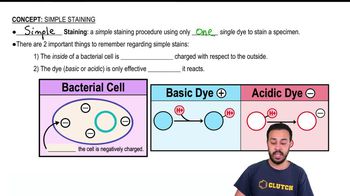
Simple Staining
3731
views
56
rank
05:30
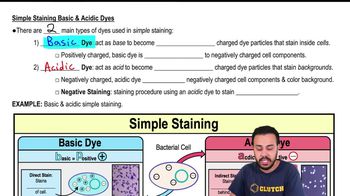
Simple Staining Basic & Acidic Dyes
3378
views
58
rank
Terms in this set (14)
Hide definitions
Simple Staining
A technique using a single dye to enhance contrast, making cells easier to visualize under bright field microscopy.
Basic Dye
A positively charged coloring agent attracted to negatively charged cell interiors, resulting in direct cell staining.
Acidic Dye
A negatively charged coloring agent that stains the background by repelling negatively charged cell interiors.
Direct Stain
A method where a positively charged dye colors the inside of cells by binding to their negatively charged components.
Indirect Stain
A method where a negatively charged dye colors the background, leaving the cell interiors unstained.
Negative Staining
A process using a negatively charged dye to color the area around cells, enhancing their visibility by contrast.
Bright Field Microscopy
A visualization technique where stained specimens appear darker against a bright background, aiding cell observation.
Cell Interior
The negatively charged region within a bacterial cell that attracts basic dyes during staining.
Cell Exterior
The more positively charged region outside a bacterial cell, contrasting with the negatively charged interior.
Hydrogen Ion
A particle involved in dye reactions, influencing whether a dye becomes positively or negatively charged.
Contrast Enhancement
The process of making cells more distinguishable from their background, often achieved through staining.
Specimen
A sample, such as a bacterial cell, prepared and stained for microscopic examination.
Charge Attraction
The phenomenon where oppositely charged molecules, such as dyes and cell components, are drawn together during staining.
Background Staining
A result of using acidic dyes, where the area surrounding cells is colored, highlighting the cells themselves.
 BackBack
 03:23
03:23