Back

Tests to Guide Antimicrobial Use quiz

Control buttons has been changed to "navigation" mode.
1/15
  • What does the minimal inhibitory concentration (MIC) represent in antimicrobial testing?

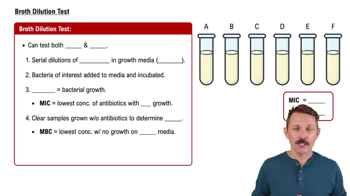
    MIC is the lowest concentration of an antibiotic that inhibits visible growth of a bacterium.
  • What is the minimal bactericidal concentration (MBC)?

    MBC is the lowest concentration of an antibiotic that kills the bacterium, not just inhibits its growth.
  • What is the main purpose of the Kirby-Bauer disk diffusion test?

    The Kirby-Bauer test determines which antibiotics are effective against a specific bacterial infection and compares their relative effectiveness.
  • How is the zone of inhibition interpreted in the Kirby-Bauer test?

    A larger zone of inhibition indicates greater bacterial susceptibility to the antibiotic on that disk.
  • Can the Kirby-Bauer test determine the exact MIC or MBC?

    No, the Kirby-Bauer test does not provide the exact MIC or MBC values.
  • What does the E test (epsilon test) use to determine MIC?

    The E test uses a plastic strip with a gradient of antibiotic concentrations to estimate the MIC where the zone of inhibition intersects the strip.
  • Does the E test provide information about whether an antibiotic is bactericidal or bacteriostatic?

    No, the E test only estimates the MIC and does not indicate if the antibiotic is bactericidal or bacteriostatic.
  • What is the main advantage of the broth dilution test over diffusion tests?

    The broth dilution test can determine both the MIC and the MBC for an antibiotic.
  • How is bacterial growth detected in the broth dilution test?

    Bacterial growth is indicated by cloudiness (turbidity) in the broth; clear broth means no growth.
  • How is the MBC determined after the broth dilution test?

    Samples from clear tubes are plated on antibiotic-free media; the lowest antibiotic concentration with no growth on the new plate is the MBC.
  • Why might the broth dilution test not always be used in clinical labs?

    The broth dilution test is more complicated and labor-intensive than diffusion tests, so it is not always used.
  • What does it mean if bacteria grow on a plate after being transferred from a clear broth tube?

    It means the antibiotic concentration in that tube was inhibitory (bacteriostatic) but not bactericidal.
  • What is the significance of distinguishing between bacteriostatic and bactericidal antibiotics?

    Distinguishing between them helps optimize treatment, especially for severe infections where killing the pathogen is crucial.
  • Why is understanding MIC and MBC important in antimicrobial therapy?

    Knowing MIC and MBC helps select the most effective antibiotic and dosage, reducing resistance and ensuring targeted therapy.
  • How do antimicrobial susceptibility tests help combat antibiotic resistance?

    They guide the selection of effective antibiotics, minimizing unnecessary use and helping prevent the development of resistance.