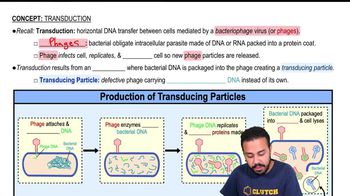
Transduction is a type of horizontal gene transfer mediated by bacteriophage viruses (phages) that transfer DNA between bacteria.
What are bacteriophages?
Bacteriophages, or phages, are viruses that infect bacteria and use the bacterial cell machinery to replicate.
How do bacteriophages replicate inside bacteria?
They inject their DNA or RNA into the bacterial cell, use the cell's machinery to replicate, and eventually cause cell lysis to release new phage particles.
What is a transducing particle?
A transducing particle is a defective phage that accidentally carries bacterial DNA instead of viral DNA.
How is bacterial DNA transferred to another bacterium during transduction?
A transducing particle injects bacterial DNA into a recipient cell, where it can integrate into the recipient's chromosome.
What are the two main types of transduction?
The two main types are generalized transduction and specialized transduction.
What type of DNA does a transducing particle contain in generalized transduction?
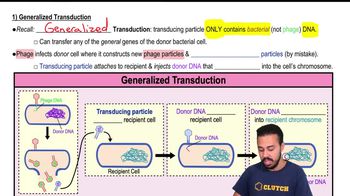
In generalized transduction, the transducing particle contains only bacterial DNA and no phage DNA.
What type of DNA does a transducing particle contain in specialized transduction?
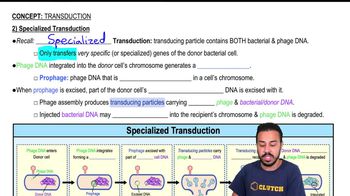
In specialized transduction, the transducing particle contains both bacterial and phage DNA.
What genes can be transferred by generalized transduction?
Generalized transduction can transfer any general genes from the donor bacterial cell.
What genes can be transferred by specialized transduction?
Specialized transduction transfers only specific genes associated with prophage formation.
How is a prophage formed during specialized transduction?
A prophage is formed when phage DNA integrates into the bacterial chromosome.
What happens when a prophage is excised during specialized transduction?
When excised, the prophage may take adjacent bacterial DNA with it, resulting in a molecule containing both phage and bacterial DNA.
How does the donor DNA integrate into the recipient cell during transduction?
The donor DNA injected by the transducing particle can integrate into the recipient cell's chromosome.
Why is generalized transduction called 'generalized'?
It is called 'generalized' because it can transfer any gene from the donor bacterial chromosome, not just specific ones.
Why is specialized transduction limited to certain genes?
Specialized transduction is limited because only genes near the prophage integration site can be excised and transferred.
 Back
Back
 04:24
04:24