Tuberculosis is caused by Mycobacterium tuberculosis, a slow-growing, acid-fast, rod-shaped bacterium with a mycolic acid-rich cell wall.
How is tuberculosis primarily transmitted from person to person?
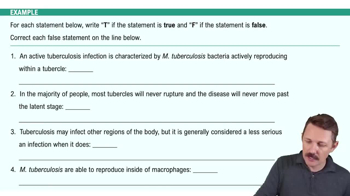
Tuberculosis is primarily transmitted via airborne respiratory droplets when an infected person coughs or sneezes.
What is the function of the mycolic acid in the cell wall of Mycobacterium tuberculosis?
Mycolic acid gives the bacterium a waxy outer layer, making it resistant to desiccation and many antibiotics, and allows it to be seen with an acid-fast stain.
What is cord factor and why is it important in TB pathogenesis?
Cord factor is a toxic glycolipid in the cell wall that helps bacteria stick together, inhibits neutrophils, and is toxic to mammalian cells, contributing to immune evasion.
What are the three stages of tuberculosis infection?
The three stages are primary (initial) infection, latent infection (with granuloma/tubercle formation), and active infection.
What is a tubercle and what role does it play in TB infection?
A tubercle is a granuloma formed by immune cells that wall off TB bacteria in the lungs during latent infection, preventing their spread.
During which stage of TB infection is a person contagious and symptomatic?
A person is contagious and symptomatic during the active infection stage, especially when coughing.
What classic symptoms are associated with active tuberculosis?
Classic symptoms include persistent cough, chest pain, and blood in the sputum (hemoptysis).
What is the Mantoux tuberculin skin test and what does a positive result indicate?
The Mantoux test involves injecting PPD into the skin and observing for an immune reaction; a positive result indicates prior exposure, latent infection, vaccination, or active disease.
What is a Ghon complex and how is it detected?
A Ghon complex is a combination of a tubercle and associated lymph node seen in a chest X-ray, indicating latent TB infection.
Why is TB treatment challenging and what does it typically require?
TB treatment is challenging due to slow bacterial growth, a protective cell wall, and drug resistance; it requires intensive multi-drug regimens.
What are multi-drug resistant (MDR) and extensively drug-resistant (XDR) TB strains?
MDR TB resists first-line drugs like isoniazid and rifampin, while XDR TB is resistant to even more drugs and is often nearly untreatable.
What is the BCG vaccine and who is it most effective for?
The BCG vaccine is used to prevent TB, offering good protection to children, especially against severe disease, but its effectiveness in adults is variable.
What happens to TB bacteria during latent infection?
During latent infection, TB bacteria are alive but walled off in tubercles, causing no symptoms and not being contagious.
How can TB bacteria spread to other parts of the body during active infection?
If a tubercle ruptures, bacteria can enter the bloodstream and spread to organs like the spleen and liver, forming new tubercles.
 Back
Back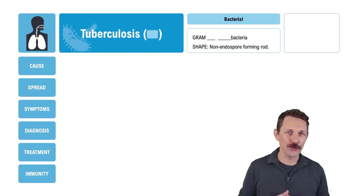
 08:15
08:15